
There are cameras that take pictures.
And then there are cameras that change the way you see.
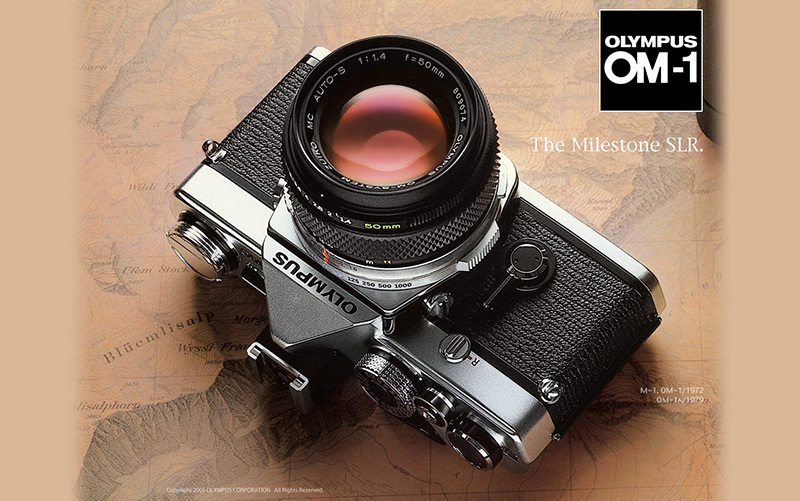
The Olympus OM-1 belongs firmly in the second category.
How to Use This Guide
This isn’t a page you’re expected to read cover to cover in one sitting – although you can if you want to. It’s designed as a reference guide you can return to whenever you need clarity on a specific part of the Olympus OM-1.
Use the table of contents to jump straight to the section that matters to you right now. Whether you’re researching the OM-1 before buying, checking reliability and servicing realities, understanding the design philosophy behind it, or simply wanting to know how it feels to live with and shoot, each section stands on its own.
Some readers will start with the history, others with practical ownership or servicing. There’s no right order. The guide is structured so you can dip in, step out, and come back later – just as you would with the camera itself.
A Camera That Changed Everything
When it appeared in 1972 – under its original short-lived name, the M-1 – the photography world was not prepared. The industry was racing toward bigger bodies, tougher frames, louder motors, thicker prisms. Serious photographers wanted professional gear, and professional gear meant weight. Strength. Mass. A tool that looked like it could double as a hammer.
Olympus did the unthinkable:
They didn’t go bigger.
They went smaller.
And that simple act – that refusal to follow the crowd – reshaped 35mm photography for the next two decades.
The Camera That Didn’t Follow the Rules
Pick up an OM-1 today and it still feels shockingly modern.
Not digital-modern, of course. But modern in the way a perfect mechanical watch feels modern: timeless, precise, engineered for the human hand rather than the spec sheet.
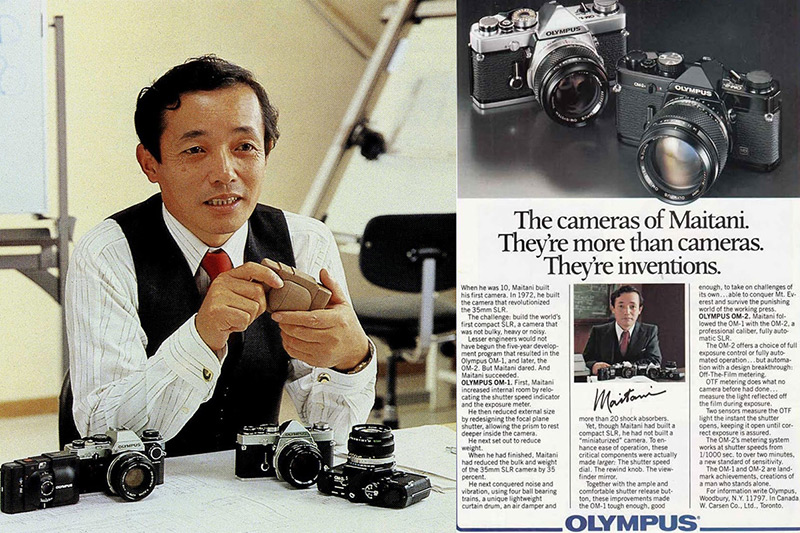
Every design choice is a message from its creator, Yoshihisa Maitani:
- You don’t need bulk to be professional.
- A camera should disappear in your hands.
- Weight is the enemy of curiosity.
- Simplicity is power.
In an era defined by big levers, big bodies, big egos, and big marketing, the OM-1 was a whisper – and the quietest voice in the room completely stole the show.
The OM-1 didn’t demand attention.
It earned it.
Maitani’s Revolution: The Human Approach
To understand the OM-1 is to understand the man behind it.
Maitani saw photographers differently from Nikon, Canon, or even Leica.
They saw technicians.
He saw people.
People who:
- walk for hours,
- chase light through strange streets,
- climb, crouch, lean, wait,
- shoot in rain, heat, winter, wind, crowds, silence, disappointment, surprise.
So he asked a question no other brand was asking:
What happens when you carry a camera all day?
That single question changed everything.
Where other brands added features, Maitani removed friction.
Where others chased speed, he chased smoothness.
Where others built armour, he built balance.
His philosophy was radical:
– A camera should free you, not weigh you down.
Olympus engineers tried to warn him that photography needed heavy pentaprisms, large mirrors, and thick metal plates.
Maitani refused.
He tore the traditional SLR architecture apart and rebuilt it from the inside, shrinking major components, rearranging internal geometry, shaving millimetres everywhere, designing a viewfinder so large and bright that Nikon shooters accused Olympus of cheating.
They weren’t cheating.
They were innovating.
The OM-1 in the Hands
The OM-1 doesn’t just look different.
It behaves differently.
It’s quiet.
A soft, dampened tchkk rather than the aggressive slap of a Nikon F2.
It’s smooth.
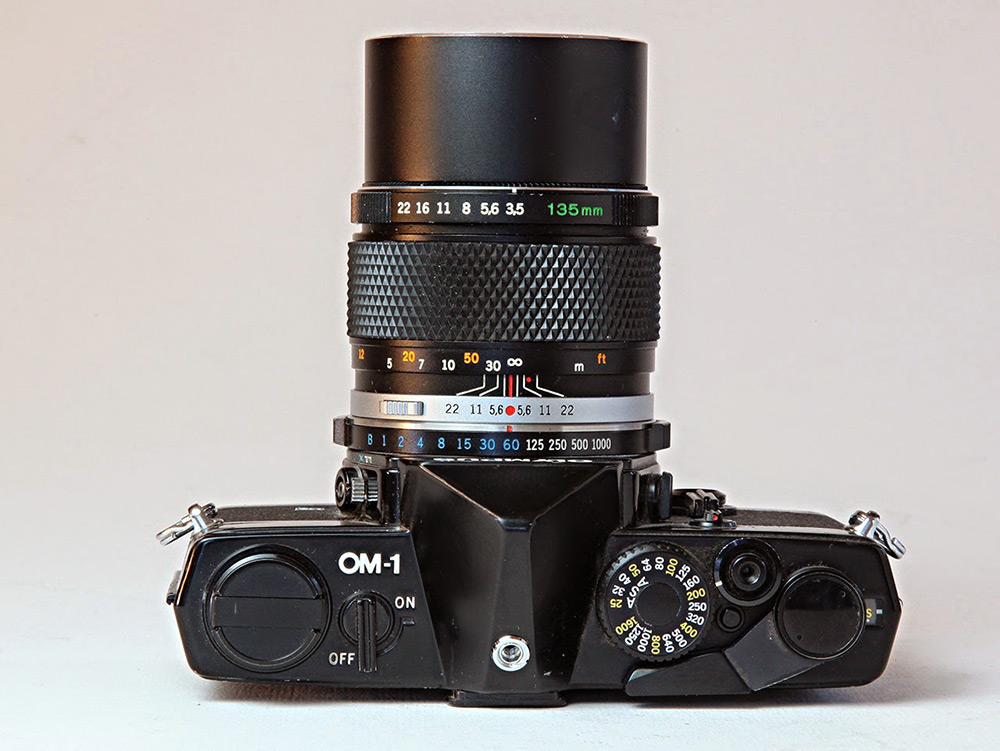
The shutter speed ring around the lens mount is so intuitive that every other layout feels clumsy afterwards.
It’s balanced.
It feels like an extension of your wrist rather than a tool you have to manage.
It’s confident.
It encourages you to trust instinct: checking light, predicting exposure, reading shadow contrast, working with what’s in front of you.
And because it’s lighter than every rival of its era – often by hundreds of grams – it encourages the one behaviour that makes all photographers better:
You carry it more.
And when you carry a camera more, you see more.
This is why so many OM-1 users say the same thing:
I shoot more with this camera than with any other SLR I own.
The OM-1 doesn’t push you.
It invites you.
A Radical Break from Nikon and Canon
To understand how revolutionary the OM-1 was, you have to imagine the landscape of 1972:
- Nikon F2: gigantic, loud, military-tough
- Canon F-1: heavy, industrial, unapologetically bulky
- Pentax Spotmatic: beloved, but still larger and heavier
Then Olympus drops an SLR that is:
- smaller than most rangefinders
- lighter than every pro SLR ever made
- quieter than anything with a flipping mirror
- built with the precision of a watch movement
Nikon dismissed it as a toy – right until war photographers and mountaineers started choosing it.
Canon said it was too small for professionals – right until magazines began printing features shot entirely on OM bodies.
Maitani didn’t care.
He once said:
A camera should be something you want to pick up.
If it is heavy, you will hesitate.
This wasn’t marketing.
This was the core of his design philosophy.
And the OM-1 proved him right.
Why the OM-1 Still Matters Today
You could argue that digital cameras made the OM-1 irrelevant.
You’d be wrong.
If anything, the OM-1 is more relevant today than ever – because modern photography is drowning in features, modes, menus, buttons, distractions, and battery anxiety.
The OM-1 brings you back to the fundamentals:
- Aperture
- Shutter
- Focus
- Light
- Timing
- Judgement
- Patience
It sharpens your eye.
It disciplines your timing.
It slows the world down just enough for you to notice things again.
It doesn’t take pictures for you.
It helps you take them yourself.
That’s why thousands of photographers are returning to the OM-1 in 2026 – not out of nostalgia, but out of exhaustion with digital complication.
The OM-1 is simple.
And simplicity is freedom.
The Meaning of Mechanical
A mechanical camera behaves differently because you complete the circuit.
You wind it.
You tension the shutter.
You set the light.
You choose the moment.
The OM-1’s mechanical shutter isn’t just a technical feature – it’s a relationship.
It builds memory in your hands.
Every click, wind, and lock becomes part of how you think photographically.
This is why OM-1 shooters develop a signature style faster.
The camera forces you to be present.
There is no LCD escape.
No menu.
No chimping.
No distraction.
Just you, the frame, and the world.
A Camera That Makes You Better
People often say:
The OM-1 made me a better photographer.
That isn’t magic.
It’s design.
Maitani designed a tool that aligns perfectly with the way human beings actually shoot:
- It’s light – so you carry it more.
- It’s quiet – so you blend into the moment.
- It’s simple – so your mind stays on the scene.
- It’s balanced – so you shoot fluidly.
- It’s mechanical – so you learn exposure properly.
The OM-1 isn’t nostalgic.
It’s instructional.
It teaches you the craft without lecturing you.
The Full Maitani Philosophy & Birth of the OM System
The Philosophy That Built a System, Not a Camera
If Part 1 was about what the OM-1 feels like, Part 2 is about why it exists, and how one man fundamentally redirected the course of camera design.
Because you cannot understand the OM-1 without understanding Yoshihisa Maitani.
He wasn’t just an engineer.
He wasn’t just a designer.
He was something far stranger, rarer, and more dangerous to the industry:
A visionary who refused to compromise.
And he did it in Japan’s most rigid corporate environment – 1960s Olympus – where hierarchy mattered more than innovation, and challenging tradition was the quickest way to stall your career.
Most people in that world moved carefully.
Maitani did not.
Before the OM-1: Maitani’s Unlikely Rise
Long before the OM-1 existed, Maitani built his reputation on two outrageous successes:
The Olympus Pen (1959)
A half-frame camera so small and elegant that it outsold full-frame systems for years. It made photography accessible to millions.
The Pen-F (1963)
The only half-frame SLR ever made – and still one of the most beautiful mechanical cameras of all time.
Both were small.
Both were radical departures from the industry norm.
Both were designed with one goal:
Make photography easier without making images worse.
He became known inside Olympus as the troublemaker who is always right.
And that’s exactly the kind of person who builds the OM-1.
Maitani vs. the Entire SLR Industry
By the late 1960s, full-frame SLRs were brutalist machines:
- large
- cold
- heavy
- industrial
- intimidating
- and designed primarily for war photographers and journalists
They were made to survive conflict, not encourage creativity.
Nikon doubled down on heft.
Canon doubled down on features.
Pentax doubled down on stability.
Leica doubled down on prestige.
Maitani doubled down on humans.
He asked questions no one else was asking:
- Why must pro cameras be heavy?
- Why does an SLR need a huge prism?
- Why do we accept vibration as normal?
- Why must the photographer work around the machine?
- Why can’t a professional system feel beautiful?
Olympus executives were sceptical.
Then he made prototypes.
Tiny prototypes.
Prototypes that felt alien – too small, too quiet, too elegant.
People laughed.
Until they looked through the viewfinder.
The Giant Viewfinder in a Small Body (The Impossible Trick)
One of the OM-1’s defining features – its enormous, bright, 97% viewfinder – is a paradox.
How can a camera smaller than a Nikon F2 have a bigger finder?
This was one of Maitani’s masterstrokes:
He redesigned the pentaprism shape
Rather than the big rectangular IBM-computer-monitor shape other brands used, Maitani trimmed and reshaped the prism geometry to recover every possible millimetre of light path.
He redesigned the mirror box
The mirror is shockingly close to the film plane but dampened with air and felt, reducing size and vibration.
He redesigned the focusing screen
It’s bright, clean, and optimised for manual focus – not TTL gimmicks.
He lowered the prism height
The camera looks sleek because it is sleek – the prism hump is almost comically small compared to its rivals.
When photographers in 1972 first held it, the most common reaction was:
How is the finder so big in such a small camera?
Even Nikon engineers visited Olympus to check whether they were using mirrors.
They weren’t.
They were using better thinking.
Quiet as a Whisper – The Air-Damped Mirror
SLR cameras are noisy because of one thing: the mirror slap.
Most brands simply accepted:
- vibration
- shock
- blur at slower shutter speeds
- the clack
Maitani refused.
He invented:
The air-damped shutter/mirror system
A soft, cushioned mirror movement that eliminated harsh vibration and gave the OM-1 its iconic tchkk.
The result:
- sharper handheld shots at slower speeds
- quieter operation for street and wildlife
- a shooting experience closer to a Leica M than a Nikon F2
This one innovation alone made photographers rethink what an SLR could be.
Why the Shutter Speed Ring Is Where It Is
Nikon put shutter speeds on top of the body.
Canon put them there too.
Everyone copied everyone else.
Maitani broke the pattern:
He put the shutter speed ring around the lens mount.
Photographers hated the idea at first.
Until they used it.
Then everything changed.
It turned out that:
- your left hand naturally sits under the lens
- your fingers naturally wrap around the ring
- you can change shutter speed without taking your eye from the viewfinder
- your right hand stays on the shutter button
Suddenly, exposure adjustments became fluid.
Maitani didn’t innovate to be different.
He innovated because he watched how real people shoot.
The OM-1 as a System, Not a Camera
This is where most guides stop.
But the OM-1 was never meant to be a standalone camera.
Maitani called it the “core of a systemâ€, and the system was built around three beliefs:
A. Professionals need a modular ecosystem
Motor drives, focusing screens, interchangeable backs, flash systems, macro rails, bellows – everything could be customised.
B. Weight must stay low across the entire system
This is why Zuiko primes are:
- small
- metal
- beautifully dampened
- rarely faster than f/2
Olympus valued optical harmony over brute-force designs.
C. Every lens should feel like it belongs
While Nikon and Canon had wildly different designs across their lens lines, Zuikos were deliberately consistent:
- same build philosophy
- same silky focusing
- same rendering DNA
Look at a frame shot on 28mm, 50mm, or 100mm Zuikos – they match.
No other system of the era achieved that coherence.
Maitani’s Secret Ingredient: Restraint
The OM-1 is a camera defined not by what’s in it
but by what Maitani refused to put in it.
No gimmicks.
No clutter.
No bells and whistles to impress spec-sheet readers.
He even fought Olympus executives who wanted more features to make it more competitive.
He famously said:
If a photographer must stop to think about a feature, it is a bad feature.
His ethos was simple:
More features = more distraction
More distraction = worse photographs
This restraint is why the OM-1 aged better than almost every 1970s SLR.
It was designed to outlive trends – and it did.
The Name That Almost Didn’t Happen
This is a fun part of OM mythology.
The OM-1 was originally named the Olympus M-1.
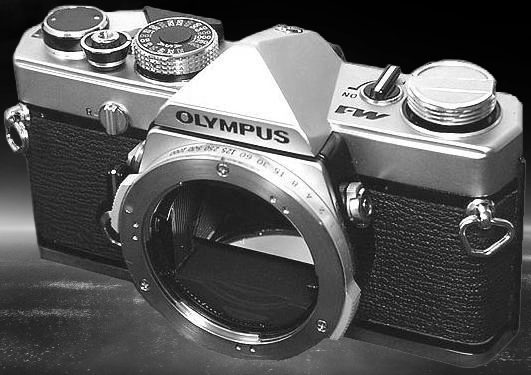
But Leica claimed the M name (M3, M4, M5) and politely told Olympus to stop using it.
Rather than fight, Maitani renamed it:
M > OM
Olympus > OM
Olympus Maitani > OM
What was meant as a concession became one of the most iconic names in camera history.
The Complete OM-1 Family: M-1, OM-1, OM-1 MD, OM-1N
Every Version, Every Serial Range, Every Change – Fully Explained
The OM-1 family looks simple on the surface, but under the hood it’s one of the most layered camera lineages of the 1970s and 80s.
This is the section that clears all the myths, all the confusion, and all the half-truths people repeat online.
Let’s start from the beginning.
The Olympus M-1 (1972)
The original. The rarest. The one that almost didn’t exist.
Before the OM-1 was called the OM-1, it was released – very briefly – as the Olympus M-1.
This version lasted only a matter of months.
Why so short-lived?
Because Leica objected.
Leica had the M3, M4, M5 series – and the letter M was their flagship identity.
Olympus, not wanting a legal war, agreed to rename the camera.
How many M-1 bodies exist?
Estimates vary, but most collectors place production between 35,000-50,000 units, possibly fewer.
You will almost never see one in the wild.
They command premium prices because of the engraving alone.
Identifying an M-1
- The top plate is engraved M-1, not OM-1.
- Serial ranges typically fall under 200,000, though a few spill slightly beyond.
- No MD engraving (motor drive system did not exist yet).
- Otherwise, technically identical to an early OM-1.
Should you buy one?
Only if:
- you’re a collector
- it’s priced very well
- or you want the rarest OM body ever made
For actual use, the later versions are better.
The OM-1 (1972-1974)
The camera that changed everything.
Once the renaming happened, the OM-1 entered full-scale production.
This is the pure OM-1 – no MD provision, no flash-ready light, no additional refinements.
Key characteristics:
- Engraved OM-1 on the top plate
- No motor-drive port
- Early versions use mercury 1.35V PX625 batteries
- Fixed-pressure plate
- Early prisms often show foam-corrosion damage today (a major buying consideration)
- Serial ranges: 200,000 – 499,999 (approx.)
What to watch for when buying:
- prism corrosion (the big killer)
- meter accuracy (almost always needs recalibration)
- stiff shutter speed ring (dried lubricants)
- degraded foam (light leaks + mirror bumper melt)
Who it’s for:
- photographers who want the original OM-1 feel
- people who don’t care about motor drives
- anyone buying fully manual OM for everyday or B&W work
3. The OM-1 MD (1974-1979)
The pro-upgrade – identical to the OM-1 but motor-drive-ready.
By 1974, Olympus realised pros wanted motor drives – especially Olympic, press, and sports shooters.
The original OM-1 could use a motor drive, but only with a permanent factory modification.
So Olympus added the upgrade from the factory:
OM-1 MD = Motor Drive Ready
A small removable cover plate on the base allowed the Motor Drive 1 to attach directly.
What changed?
Only one thing:
A physical port for the motor drive.
Everything else:
- shutter
- meter
- mirror box
- viewfinder
- build
is identical to a standard OM-1.
Serial ranges:
- approx. 500,000 – 899,999
Who this model suits:
- collectors wanting a more flexible OM-1
- working photographers who enjoy shooting bursts
- people wanting a better chance of a later, less-corroded prism
A hidden advantage:
OM-1 MD bodies were often bought by more serious users, better cared for, more likely to be serviced, less likely to be abused.
4. The OM-1N (1979-1987)
The final, refined, and most practical OM-1.
This is the version most shooters should buy today.
Olympus didn’t redesign the camera.
They polished it.
Improvements include:
A. Flash-ready LED in the viewfinder
When using T-series flashes, the LED confirms charge status.
Simple but genuinely useful.
B. Smoother shutter speed ring
Later lubrication + improved machining gives it the best feel of all OM-1 variants.
C. Refined advance mechanism
Longer-lasting, smoother, more reliable under heavy use.
D. Slightly improved meter behaviour
Tolerates 1.5V batteries more gracefully (still not perfect, but much better).
E. MD compatibility
Built-in, of course.
Serial ranges:
- generally 900,000+, though overlap exists
- some dip as low as 880,000, but 900k+ is the usual rule
Why the OM-1N is the best user-choice:
- highest chance of clean prism
- best mechanics
- easiest to service
- most stable meter
- most refined feel
Collectors may prefer an M-1.
Shooters should prefer an OM-1N.
Full OM-1 Family Comparison Table
| Model | Years | Motor Drive | Prism Risk | Meter Behaviour | Flash Ready | Best For |
| M-1 | 1972 | No | High | 1.35V only | No | Collectors |
| OM-1 | 1972-74 | No | High | 1.35V only | No | Purists |
| OM-1 MD | 1974-79 | Yes | Moderate | 1.35V only | No | Hybrid collectors/users |
| OM-1N | 1979-87 | Yes | Lower | Handles 1.5V better | Yes | Everyday shooters |
Serial Numbers: The Practical Reference Chart
This is based on repair-shop logs and collector databases – the closest we can get to a reliable guide.
M-1: 100,000 – 199,999
OM-1: 200,000 – 499,999
OM-1 MD: 500,000 – 899,999
OM-1N: 900,000+ (some overlap)
Note: Serial overlaps exist because Olympus used multiple production lines and often built sub-batches simultaneously.
Buying Advice – What to Choose in 2025/26
For actual shooting:
OM-1N
Most reliable, least corrosion, most refined, easiest to live with.
For value:
OM-1 MD
Usually cheaper than an OM-1N and almost identical in use.
For collectors:
M-1
But be prepared to pay.
For nostalgic purists:
Early OM-1
The closest thing to holding 1972 in your hand.
Known Issues, Prism Rot, Battery Reality, Servicing and How to Buy an OM-1 in 2026
This is the truth-telling section – the part most online guides either gloss over or get completely wrong.
If someone is buying an OM-1 today, this is the section that saves them money, time, and heartbreak.
Let’s go deep.
1. The Big One: Prism Rot (What It Is, Why It Happens, and How to Spot It)
The OM-1s biggest flaw isn’t the shutter.
It isn’t the mechanics.
It isn’t the meter.
It’s the foam strip above the prism.
Olympus used a thin strip of sound-deadening foam in early OM-1, OM-1 MD, and even some OM-1N bodies.
Over decades it turned acidic, corroding the prism’s reflective coating.
The result?
- dark patches
- blotches
- mottling
- smudged areas in the viewfinder
- dirty corners that can’t be cleaned
This is the number one reason OM-1 prices vary wildly.
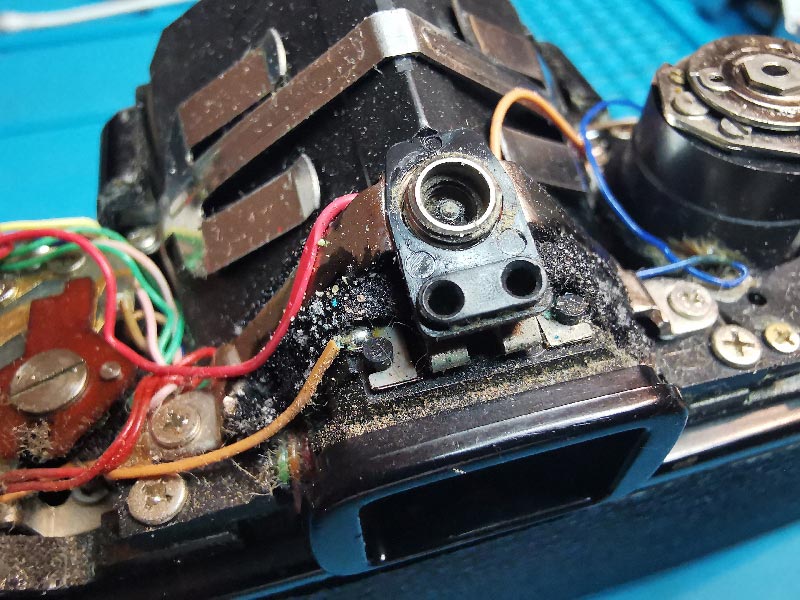
How to check for prism rot:
Hold the camera to your eye and:
- look at the top centre of the finder
- look for two small dark circles
- sweep side-to-side to detect blotches
- shine a soft light from above and check for dullness
Any rot = prism replacement needed.
Does it affect the images?
No
But it affects:
- focusing accuracy
- composition
- resale value
Replacing the prism is now a standard part of an OM-1 service.
If you buy an OM-1 today, assume it needs prism work unless proven otherwise.
2. Light Seals and Mirror Bumper: They’re Almost Always Melted
Light seals degrade into sticky, gummy tar.
Every OM-1 older than 30 years eventually needs:
- door channel seals
- hinge seal
- mirror bumper
If not replaced:
- the mirror can stick
- the foam can smear onto the mirror
- the sticky residue can leak onto the shutter curtains
This is inexpensive to fix during a CLA, but a disaster if ignored.
3. The Battery Reality (Mercury vs Modern Cells)
The OM-1 was designed for 1.35V PX625 mercury batteries, now banned.
Options today:
A. Zinc-air hearing-aid batteries (1.35V equivalent)
Closest match.
Cons: short life.
B. Modern 1.5V silver oxide with voltage adapter
Most accurate solution.
The adapter drops the voltage to 1.35V.
C. Recalibrated meter during service (best long-term fix)
Most technicians recalibrate the meter so modern 1.5V batteries read correctly without adapters.
If the body is serviced, this is the recommended approach.
4. The Meter: Brilliant, But Often Out of Spec
The OM-1’s meter is beautifully simple and very accurate when working.
However
Nearly every unserviced OM-1 today suffers from:
- drift
- old solder
- failing low-tolerance resistors
- dust and oxidation on contacts
This is why meters often read:
- too high
- too low
- or flutter erratically
A technician can stabilise the entire circuit during a CLA.
5. The Shutter: Usually Fine, Rarely the Problem
Unlike many SLRs of the era, the OM-1’s shutter is:
- robust
- predictable
- well-engineered
The main issues come from:
- dried lubricants
- stiff shutter speed rings
- slow 1s speeds
- mirror return lag
All solved during service.
6. The Viewfinder: Why OM-1 Finders Are Often Dirty
OM-1 viewfinders accumulate:
- dust
- fibres
- old foam particles
- haze from evaporated lubricants
This is normal.
A proper CLA cleans the prism housing and condenser lens.
Avoid disassembling the finder at home unless you know the OM system – the prism is easily scratched.
7. What a Proper OM-1 CLA Includes
A full service should include:
Mechanical:
- shutter timing
- lubrication of shutter speed ring
- mirror mechanism clean
- film advance rebuild
- rewind system clean
- self-timer overhaul
- mirror lock-up check
Optical:
- new prism (if needed)
- viewfinder cleaning
- condenser clean
- focusing screen clean
Light Seals:
- full replacement
- mirror bumper replacement
Meter:
- recalibration for 1.5V
- resistor check
- solder clean
- voltage stability test
This is the difference between a 3-month camera and a 30-year camera.
8. How Much Should a Full Service Cost?
UK 2026 realistic prices:
- £80-£120 for a standard CLA
- £40-£70 for prism replacement
- £120-£170 total for full overhaul
Bodies serviced by well-known techs sell much higher.
9. What to Inspect Before Buying an OM-1 (The Zero-Mistake Checklist)
Always check:
- viewfinder for dark patches (prism rot)
- meter movement (smooth or jittery?)
- shutter speeds (1s should be close to 1s)
- mirror return (snappy or lagging?)
- shutter speed ring (free or stiff?)
- film advance stroke (smooth or grinding?)
- battery compartment corrosion dented top plate corners (sign of drops)
- back door hinge (common bending area)
- squeak in the mirror (dry lubrication)
Also check:
- serial number (helps identify version)
- MD plate present (for OM-1 MD / OM-1N)
- focusing screen cleanliness
- prism edges
How to Shoot the OM-1 at Its Absolute Best
The OM-1 is not a modern camera.
It’s better than that.
It’s a machine designed with a philosophy – a camera that rewards the photographer who slows down, feels the moment, and trusts their instincts.
Here’s how to get the most out of it.
1. Master the OM Way: Keep Your Eye in the Finder
Most SLRs force you to look away from the finder to change shutter speeds.
The OM-1 does not.
The shutter speed ring is around the lens mount for one reason:
So the photographer never breaks concentration.
This is the single biggest change you can make in your handling technique:
Keep your eye in the finder.
Adjust shutter speed by feel.
Stay inside the moment.
This one habit alone makes your shooting faster, smoother and more immersive.
2. The OM Grip (How Maitani Intended You to Hold It)
The camera works best with:
- left hand cupped under the lens
- thumb and index finger rotating the shutter ring
- right hand for advance, shutter and focus
It’s balanced, stable, and extremely fast.
The OM-1 encourages a two-handed flow, which reduces shake and improves precision – especially at 1/30 and 1/15, where mirror damping genuinely helps.
3. Exposure Technique: Shoot the OM-1 Like It’s a Slide Camera
Although it’s a negative-film camera, the OM-1 meter is very tight.
It rewards:
- deliberate metering
- holding exposure
- choosing a tone to anchor your reading
The classic technique:
- Identify the mid-tone in your scene (shadow side of skin, pavement, tree bark).
- Point meter at it.
- Half-press to read.
- Set shutter/ISO accordingly.
- Recompose. Shoot.
This is the foundation of OM exposure.
Maitani designed it this way.
4. Overexpose Colour, Underexpose B&W (The OM Rule)
The OM-1 is incredibly consistent when you follow this simple rule:
Colour negative film = +1 stop
(Ektar, Gold, Portra, ColorPlus)
- richer colour
- cleaner shadows
- smoother skin
- more forgiving highlights
- Black and white = 1/3 to 1 stop
(Tri-X, HP5, FP4)
- stronger contrast
- denser blacks
- more cinematic look
- makes the OM lenses come alive
5. Slow Down for Five Frames Per Roll
The OM-1 was designed for thoughtful photography, not spraying.
Try adding this ritual:
For every roll, pick five frames where you slow down deliberately:
- breathe
- meter
- check edges
- lean in physically
- wait for the decisive moment
This is how Maitani himself shot.
It permanently makes you a better photographer.
6. Learn Your Lenses (The Zuiko Look Comes From Practice)
Zuiko primes aren’t perfect.
They’re personal.
Each has a look:
- 28mm f/3.5 – clean, neutral, honest
- 50mm f/1.8 MIJ – sharp, modern contrast
- 50mm f/1.4 Silver Nose – glowing, romantic
- 85mm f/2 -gentle depth
- 100mm f/2.8 – crisp, quiet telephoto
Your photos change dramatically depending on how you pair:
- the lens
- the film
- the light
So treat each lens as a character:
- the 50mm as the storyteller
- the 28mm as the witness
- the 85mm as the poet
This is how OM shooters find their style.
7. The Maitani Triangle of Scenes
If you don’t know what to shoot, Maitani offered a simple way to train the eye:
Each day, find:
- One shadow scene
- One bright scene
- One texture scene
Then expose carefully.
Do this for a month and your sense of tone becomes instinctive.
8. Use Mirror Lock-Up for Three Things Only
Despite being famous for having MLU, most people misuse it.
You only need it for:
- Long exposures
- Macro
- Ultra-critical tripod shots
Anything handheld above 1/15?
The OM-1’s air-damped mirror already handles it.
9. The Tripod Rule That Nobody Talks About
The OM-1 is tiny.
Most tripods are too big for it.
A small camera on a huge tripod = micro-vibrations.
Best tripod pairing:
- Travel-sized carbon fibre
- 1-1.2kg
- short centre column
- lightweight ball head
The OM-1 becomes a precision instrument with a proper small tripod.
10. Film Stock + Lighting Cheat Codes
This is the part people screenshot.
Sunlight:
- Ektar (landscape)
- Gold (everyday warmth)
- Tri-X (poetry)
Shade:
- Portra 400
- HP5
Indoors:
- Portra 400
- Delta 3200
Night:
- CineStill 800T
- HP5 pushed to 1600
Overcast:
- FP4
- Portra 160
- Tri-X at box speed
Everything pairs beautifully with Zuiko lenses when matched to the light.
11. The Focusing Screen Trick (The OM-1 Secret Weapon)
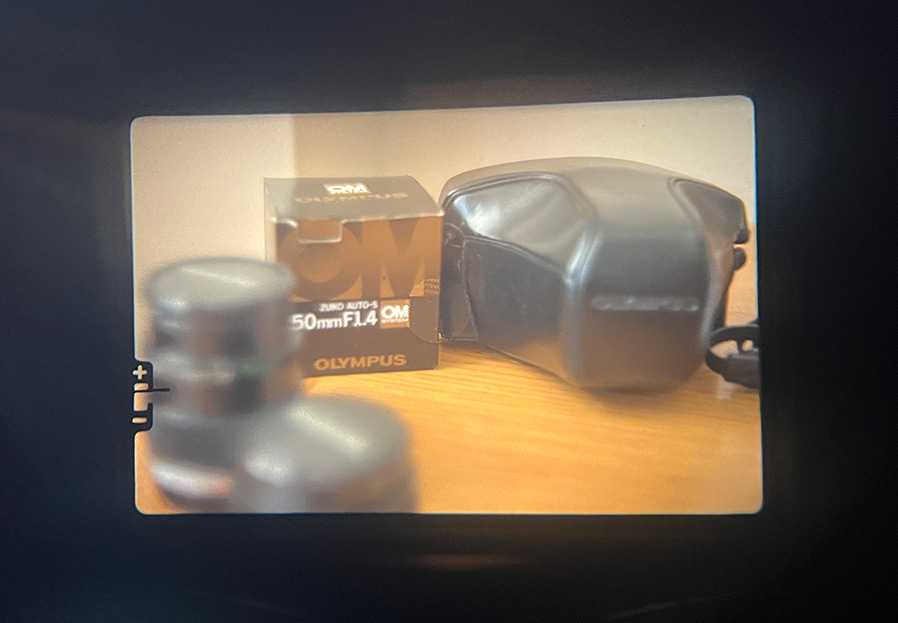
- Most OM-1 screens have:a centre microprism
- a central split image
- matte field
But the magic happens when you ignore the split image.
Use the matte field only.
It makes focusing faster and more accurate for:
- portraits
- street
- backlit scenes
- low light
The split image blacks out easily.
The matte field never lies.
12. The Perfect OM-1 Workflow (A 10-Step Shooting Ritual)
Here’s the flow that produces consistently strong photographs:
- Load film mindfully
- Advance to frame 1
- Meter for mid-tone
- Set exposure by feel
- Focus on the matte field
- Keep eye in the finder
- Adjust shutter on the lens ring
- Exhale before pressing
- Advance smoothly
- Listen to the camera, not the scene
This creates a rhythm – the signature OM rhythm.
13. The OM-1 Is Best When You Don’t Rush It
The camera rewards:
- patience
- craft
- the small details
It’s a camera that slows the world down just enough for you to see it properly.
If you respect the OM-1’s design philosophy, it elevates your photography in return.
How to Use the OM-1 for Every Shooting Style (Street, Portraits, Travel, Documentary & B&W)
The OM-1 is a shape-shifter.
It becomes a different camera depending on your lens choice, your film, and your mindset.
Below are the five core styles most OM shooters explore – and how to get the best results in each.
This is not theory.
This is real workflow you can apply the next time you go out.
1. Street Photography
Invisible, quiet, instinctive
The OM-1 is one of the greatest street cameras ever made because it removes everything that interrupts flow.
Recommended setup
- Lens: 35mm f/2.8
- Film: HP5 (400), Tri-X (400)
- Exposure: Zone pre-metering
- Focus: Hyperfocal (f/8 or f/11)
How to shoot
- Pre-meter once when you arrive in an area.
- Set exposure manually and leave it.
- Lift, frame, shoot.
- Keep the 35mm on for the entire walk.
- Shoot from the chest or hip when needed – the OM shutter is incredibly quiet.
What to look for
- gestures
- layers
- geometry
- light on faces
- shadows of people entering frame
- silhouettes
Why the OM-1 excels here
The OM-1’s damping makes hand-held shots at 1/15 and 1/30 unusually sharp.
You become a ghost with a camera.
2. Portraits
Glow, intimacy, skin, connection
Zuiko portrait lenses have a signature look – soft highlight roll-off, gentle rendering, and beautiful falloff.
Recommended setup
- Lens: 50mm f/1.4 (Silver Nose) or 85mm f/2
- Film: Portra 400, Portra 160, Delta 100, Tri-X
- Exposure: Under by 1/3 stop for B&W, over by 1 stop for colour
How to shoot
- Focus using only the matte field – NOT the split image.
- Shoot wide open or at f/2 for softness, stop down to f/4 for clarity.
- Use window light, backlight, and side light.
- Bring the camera slightly lower than eye level – the OM-1 finder encourages this compositional angle.
What to look for
- hands
- eyelashes
- profiles
- soft backgrounds
- contrasts between bright and shadowed skin
Why the OM-1 excels here
The huge finder makes it easy to see micro-expressions.
The shutter is quiet enough to preserve the moment.
3. Travel & Landscape
Weightless freedom, big vistas, texture
This is where the OM-1 feels like cheating – it’s so light you can walk all day without noticing it.
Recommended setup
- Lenses: 24mm + 50mm
- Film: Ektar 100, Gold 200, Portra 160
- Exposure: Over 1 stop for colour
- Extras: Tripod + ND filter if shooting seascapes
How to shoot
- Start with the 24mm – it tells the landscape honestly.
- Switch to 50mm for intimate scenes, food, people, market details.
- For seascapes, use a 2-4 stop ND and the OM-1 mirror-lock-up for long exposures.
- Compose low – wide Zuikos love foreground texture.
What to look for
- leading lines
- reflections
- rocks, water, plants
- dramatic clouds
- repeating shapes
- textures
Why the OM-1 excels here
It’s the one SLR that truly works as a travel companion – no fatigue, no bulk, just pure image-making.
4. Documentary & Storytelling
Honest, quiet, observational photography
The OM-1’s silence and small size make it perfect for the kind of work where presence must be subtle.
Recommended setup
- Lenses: 24mm + 35mm + 100mm
- Film: HP5, Tri-X, Portra 400
- Exposure: Keep settings consistent for continuity in the story
How to shoot
- Work in sequences – not single frames.
- Move around your subject in arcs and circles.
- Use the 24mm for context, 35mm for the core story, 100mm for quiet details.
- Stay close enough to feel part of the environment.
What to look for
- hands doing something
- the environment people are in
- small rituals
- repetition
- transitions in the day
Why the OM-1 excels here
It creates trust.
People forget it’s there.
That is the dream for documentary work.
5. Black & White (The Noir Mode)
“Shape, shadow, geometry, atmosphereâ€
The OM-1 was born for black & white film – especially Tri-X and HP5.
Zuikos have a tonal signature that comes alive in monochrome:
- deep blacks
- strong mid-tones
- soft highlight roll
- perfect grain structure
Recommended setup
- Lenses: 28mm f/2, 50mm f/1.4 (Late MC), 85mm f/2
- Film: Tri-X, HP5, FP4
- Exposure: Underexpose by 1/3 to 2/3 stop
How to shoot B&W
- Think in layers – build depth through foreground elements.
- Use shadow as a character.
- Shoot high contrast scenes on purpose – Zuikos handle them beautifully.
- Look for strong diagonals and repeating shapes.
What to look for
- silhouettes
- hard sunlight
- window shadows
- alleyways
- backlit figures
Why the OM-1 excels here
The meter is predictable and the lenses have beautiful micro-contrast – two foundations of classic B&W photography.
Maintenance, CLA, Prism Rot, Battery Mods, Light Seals, Troubleshooting & Long-Term Care
The Olympus OM-1 is a masterpiece of mechanical engineering – but it is also a 50-year-old machine, and every 50-year-old machine needs care.
This section gives you everything you need to keep your OM-1 running for the next half-century.
Think of this as the ownership Bible.
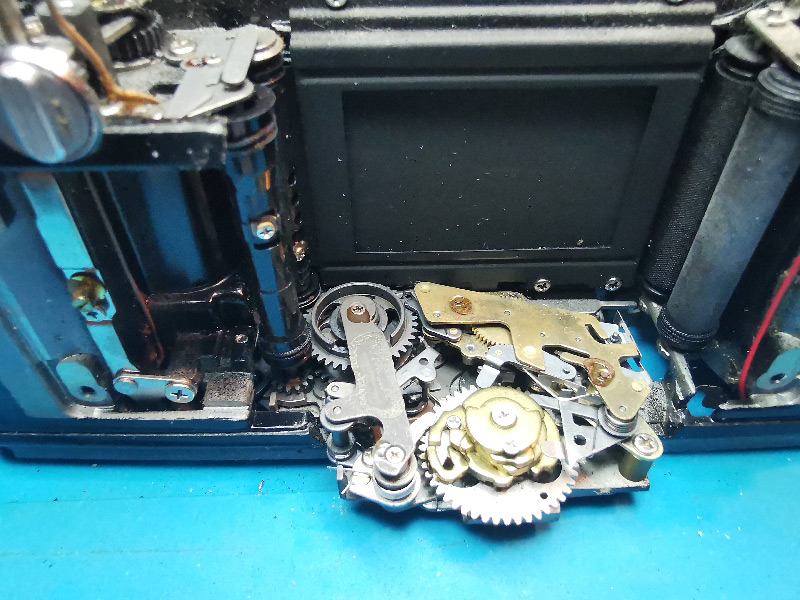
1. CLA – What It Is, Why It Matters, and When You Need It
CLA = Clean, Lubricate, Adjust
A proper CLA transforms an OM-1.
Not makes it slightly nicer.
Transforms it.
Before CLA:
- stiff shutter speeds
- inconsistent exposures
- sticky mirror return
- inaccurate meter
- rough wind-on
- loud, metallic mirror slap
After CLA:
- smooth advance
- accurate shutter
- quiet damping
- reliable meter
- consistent exposures
- a camera that feels alive again
How often should you CLA an OM-1?
- Every 10-15 years if lightly used
- Every 5-7 years if shot weekly
Immediately if:
- the shutter hesitates at 1s–1/15
- the mirror sticks
- the wind lever feels gritty
- the meter jumps or flickers
- you hear a ping from the mirror box
Who should you get your camera serviced? (UK)
Avoid DIY unless you’re confident – the OM-1’s prism assembly is delicate.
2. Battery Mods: The 1.35v 1.5v Reality
The OM-1’s meter was designed for 1.35v mercury cells.
Those don’t exist anymore.
You have three options:
Option A – Don’t use the meter at all
This is what many serious OM-1 users do.
Shoot Sunny 16 or carry a handheld meter.
The camera is fully mechanical.
Option B – Use a zinc-air 1.35v battery (Wein Cell)
Pros: perfect voltage
Cons: short life, inconsistent in cold, expensive long-term
Option C – Convert the OM-1 to 1.5v
This is the best solution.
A technician adjusts the meter circuit to read correctly with silver-oxide SR44 cells.
Do this once, never think about batteries again.
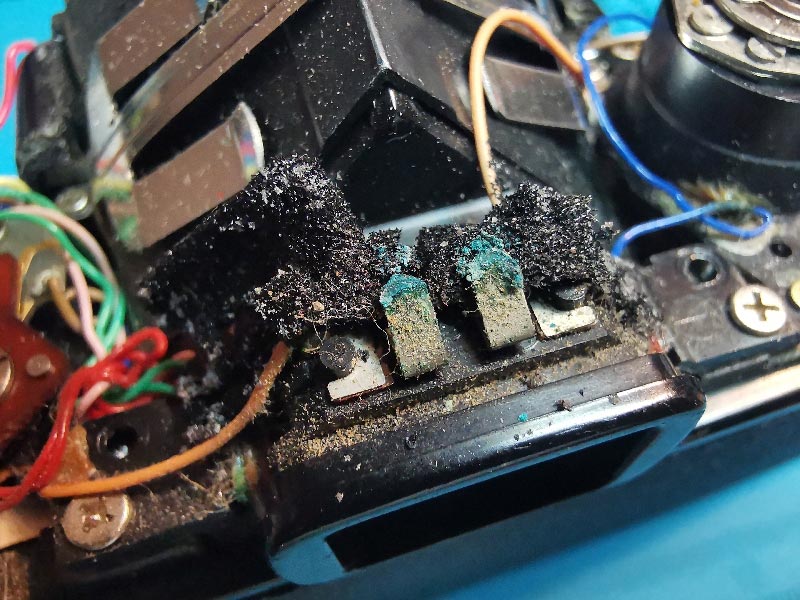
3. Prism Rot – What It Is and Why It Happens
This is the OM-1’s Achilles heel.
What prism rot looks like
- dark patches at the top of the viewfinder
- green or black edges
- mirroring around the split image
- foggy or mouldy-looking corners
Why it happens
Olympus used foam around the prism as a shock absorber.
Over decades, this foam:
- melts
- turns acidic
- eats the prism’s silvering
- permanently destroys the reflective coating
Once this happens, there is no repair – only replacement.
Why this matters when choosing an OM-1
Prism rot doesn’t affect the image on film, but it does affect the viewfinder – and the value of the body. If a prism has to be replaced, that’s an extra future cost, so it’s one of the most important things to check before buying.
Fix
- A technician removes the foam
- Cleans the prism housing
- Replaces with inert foam
- Installs a replacement prism if needed
If your OM-1 hasn’t had the prism foam removed, it is living on borrowed time.
4. Light Seals & Mirror Bumpers
Why they matter
Old seals:
- crumble
- melt into black tar
- leak light
- shed sticky residue inside the camera
Most OM-1s need:
- back door light seal replacement
- mirror bumper replacement (the small foam at the top of the mirror box)
DIY or technician?
DIY is possible if:
- you’re patient
- you use proper pre-cut seal kits
- you don’t use kitchen sponge
Otherwise:
Let a technician do it during the CLA.
5. Common OM-1 Problems & How to Fix Them
Problem #1 – Mirror sticks halfway up
Cause: dried lubrication
Fix: CLA
Problem #2 – Slow shutter speeds lag (1s, 1/2, 1/4)
Cause: timing gears need cleaning
Fix: CLA
Problem #3 – Shutter speeds above 1/250 are inconsistent
Fix: CLA + testing on a shutter speed machine
Problem #4 – Wind-on lever feels rough
Cause: old grease
Fix: lubrication during CLA
Problem #5 – Meter needle wavers or jumps
Cause: battery voltage OR dirty contacts
Fix: battery mod + cleaning
Problem #6 – Viewfinder debris or dust
Cause: dust on the focusing screen
Fix: removable screen on OM-1N only – earlier OM-1 requires top-plate removal
Problem #7 – Film advance locks mid-roll
Cause: frame counter gear slipping
Fix: technician reset
Problem #8 – Light leaks
Cause: door seals
Fix: replace seals
Problem #9 – Shutter squeals
Cause: dry shutter springs
Fix: lubrication
Problem #10 – Black corners in finder
Cause: prism rot
Fix: replacement
6. Long-Term Care: The OM-1 Survival Plan
Do this and your OM-1 will outlive you.
1. Store without tension
- Unwind shutter
- Leave camera in resting state
- Do NOT leave the shutter cocked
2. Fire the shutter through all speeds once a month
This keeps lubricants moving.
3. Keep it dry
Humidity = fungus.
Keep silica gel packs in your camera bag.
4. Avoid high heat
Don’t leave the OM-1 in a hot car – prism cement can separate under extreme heat.
5. Clean lenses properly
- blower
- soft brush
- microfibre cloth
- never household wipes
6. Replace seals every 10-15 years
Even if they look fine.
Old seals fail suddenly.
7. Use the right batteries
Either 1.35v zinc-air or a properly calibrated 1.5v conversion.
8. Service every decade
A CLA is cheaper than repairing damage from neglect.
7. The Should I Buy This OM-1 Checklist
Use this before buying, selling, or accepting a trade:
YES if the camera:
- has no prism rot
- fires consistently at all speeds
- has smooth wind-on
- has clean seals
- has no dented prism top
- meter responds (even if inaccurate)
- finder is clear
NO if the camera:
- has black patches in the finder
- has a locked shutter
- has squealing sounds
- has tar-like door seals
- shows fungus in prism
- has a broken self-timer lever
- has corroded battery chamber
8. A Realistic Ownership Timeline
Year 0-1
Buy, inspect, CLA, seal replacement and battery mod.
Year 1-10
Shoot regularly.
Store properly.
Clean lenses.
Fire shutter monthly.
Year 10-20
Second CLA.
Replace seals again.
Year 20-30
Probably still going strong.
OM-1s are simple machines.
They don’t die if cared for.
Year 30-40.
You hand it to someone younger –
and it still works.
Buying an OM-1 in 2026: A Clean, Practical Guide
The OM-1 is one of the most rewarding film cameras you can own – but it’s also 40-50 years old, and buying one today requires a bit of knowledge.
This chapter walks through everything a buyer should check, avoid, and look for, whether purchasing online or in person.
This is the practical reference section readers will return to whenever they’re choosing a body.
1. The Three Versions, Explained Simply
There are only three OM-1 bodies that most people will encounter:
OM-1 (1972-1974) – The Original
- Pure mechanical design.
- No motor drive port unless factory-modified.
- Often in poorer condition due to age.
- Collectible early M-1 variants exist under ~200,000 serials.
OM-1 MD (1974-1979) – The Standard Choice
- Identical to OM-1 but motor-drive ready from factory.
- Removable plate on the base.
- Most plentiful version on the market.
- Generally the safest buy.
OM-1N (1979-1987) – The Improved Version
- Flash-ready indicator in the viewfinder.
- Smoother film advance and clickier shutter ring.
- Slight metering updates.
- Usually the most reliable used option.
If someone is buying their first OM-1 today, the OM-1N or OM-1 MD is the most practical choice.
2. What to Check Before You Buy
Buying a 50-year-old mechanical camera is surprisingly simple – as long as you know what to look for.
Think of this as a pocket inspection checklist you can run through in under two minutes.
1. Check the prism (the most important test)
Look through the viewfinder against a bright wall or a clear sky.
You’re checking for:
- brown patches
- silver blotches
- milky haze
- dark corners
These are signs of prism rot, caused by old deteriorating foam inside the prism housing.
Good news:
It’s completely repairable, but it should reduce the asking price by £40-£120 depending on severity.
2. Check the light meter – but don’t panic if it’s dead
The OM-1 is a fully mechanical camera.
The meter is the only electronic part.
What to test:
- Insert a modern 1.5V battery (LR44 or SR44 with an adaptor)
- Check that the needle moves when you change shutter speed or aperture
- Aim at bright vs dark areas
If the needle responds, meter works.
If not, the camera still works perfectly without it.
Many OM-1 shooters ignore the meter entirely and shoot manually or with a phone app. A dead meter should reduce the price, but it isn’t a deal breaker.
3. Test the shutter speeds
Fire the shutter at:
- 1s
- 1/2
- 1/4
- 1/60
- 1/1000
Slow speeds should sound clean, even, and not sluggish.
Inconsistent slow speeds mean the camera wants a CLA – normal for its age and not doom.
4. Test the film advance
A healthy OM-1 has:
- a smooth wind stroke
- no grinding
- no slipping
- a positive frame-stop click
A sticky advance usually just means dried lubrication.
5. Inspect foam and seals
Check:
- mirror bumper
- film door seals
- light trap channel at the hinge
If the foam is gooey or powdery, it needs replacing (£10-£25).
This is expected maintenance on any OM-1.
6. Check for internal haze or fungus
Hold the shutter open (on Bulb), shine a torch through the mount.
Look for:
- milkiness
- rainbow haze
- fungus threads
Most minor haze is fully fixable during a service. Heavy fungus = skip the listing.
7. Check shutter curtains
They should be:
- black and even
- not wrinkled
- not dented
- not oily
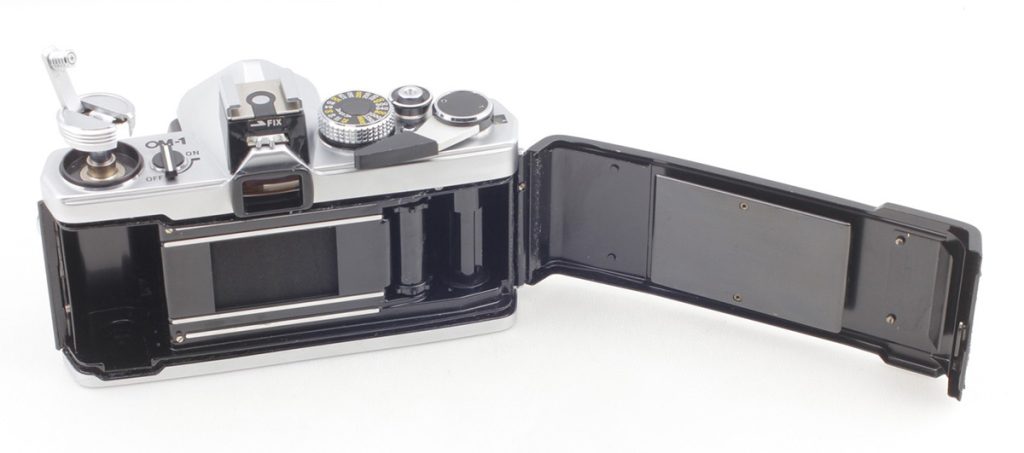
Curtain dents often signal a drop or impact.
8. Ask for these 3 extra photos from sellers
Essential images:
- Through the viewfinder
- Shutter curtains
- Film chamber close-up (hinges + seals)
Any seller who won’t provide these, avoid.
Where to Buy Olympus OM-1 Bodies Safely
Buying a 50-year-old camera online can feel risky, but there are several sellers and stores that consistently handle film gear properly, list honest descriptions, and provide enough photos to judge condition. These sources give readers the best chance of finding a healthy OM-1 without surprises.
Recommended UK Sellers
A long-standing specialist with reliable grading.
Pros: honest condition notes, clear photos, warranty options.
2. London Camera Exchange (LCE)
Often carries serviced or well-tested OM bodies.
Pros: nationwide branches, the ability to inspect in person, fair pricing.
3. Vintage Classic Cameras (UK)
Independent seller focused on mechanical film cameras.
Pros: knowledgeable, film-first grading, regularly stocks OM bodies.
4. Specialist Dealers on Etsy (Film Camera Stores)
Several curated vintage shops deal only in film SLRs.
Pros: detailed listings, buyer protection, easy returns.
5. Reputable eBay Sellers With Strong Film History
Not all eBay stores are equal – the reliable ones have:
- high feedback specifically for film gear
- detailed condition photos
- the ability to request extra images (VF, curtains, seals)
- clear descriptions of known issues (meter, foam, speeds)
Tip: Always check the seller history – not just the numbers.
What to Avoid
Avoid listings that show:
- Untested – no battery to check
- 3-4 photos maximum
- No viewfinder photo
- No shutter curtain close-up
- Descriptions like found in loft / attic camera
- Cameras described only as minty or looks unused without internal photos
These signals usually mean the seller hasn’t inspected the camera or doesn’t understand film gear.
Buying Internationally
KEH Camera
Highly reliable film grading and good warranties.
Japanese eBay Sellers With 99.5%+ Feedback
Japan often has the cleanest OM bodies in the world.
Look for listings with:
- full internal photos
- prism shots
- shutter curtain diagrams
- notes about meter function
- no haze/fungus statements
Shipping and tax can add cost (plan for 30% additional on price), but condition is often exceptional.
Quick Reader Tip
If a listing shows:
- a clean prism
- smooth advance
- working meter
- tidy seals
- no curtain dents
- and honest photos
it’s almost always a safe buy.
Why this matters
Buying an OM-1 isn’t like buying a modern camera – condition varies wildly after 40-50 years.
A few minutes of smart checking saves you money, avoids lemons, and gives you a body that lasts decades.
The Most Common OM-1 Problems
Prism Rot
The big one. Checkerboard stains or silver blotches.
Fix: prism swap.
Normal cost: £60-£120.
Meter Dead / Unstable
Effect: none – camera still 100% mechanical.
Fix: voltage conversion or minor solder work.
Sticky Slow Speeds
Very common in cameras that haven’t been serviced in 30-40 years.
Fix: CLA.
Cost: £100-£150.
Mirror Sticking
Usually old foam.
Fix: cheap and quick.
Corroded battery compartment
Fixable if mild. Walk away if severe.
Worn shutter curtain edges
Usually cosmetic, but deep dents are a red flag.
What You Should Expect to Pay
| Model | Used Condition | Very Clean | Fully Serviced |
| OM-1 | £60-120 | £120-180 | £180-220 |
| OM-1 MD | £100-150 | £150-200 | £200-250 |
| OM-1N | £100-150 | £150-200 | £200-250 |
| M-1 Collector only | £350-700 (varies) |
These are real 2026 UK prices, not inflated dealer guesses.
The Best Version for Most Shooters
OM-1N – newest, smoothest, most stable.
OM-1 MD – second-best choice, widely available.
Early OM-1 bodies (<500k) are wonderful, but their age shows more often.
The Don’t-Stress List (What Doesn’t Matter)
- Top plate scratches
- Replaced seals
- Slight meter inaccuracy
- Worn shutter-speed numbers
- Light marks in viewfinder that vanish during shooting
- A loud shutter (it’s normal – the OM-1 is damped, not silent)
What matters is:
- clean prism
- smooth advance
- healthy shutter
- honest seller
If those four boxes tick, you’ve found a good one.
OM-1 Pre-Purchase Inspection Checklist
A structured inspection process reveals the true condition of any Olympus OM-1, OM-1 MD, or OM-1N. Age alone tells only part of the story; mechanical accuracy, optical condition, and structural integrity determine long-term reliability. This checklist consolidates the essential points used by technicians, collectors, and dealers when assessing OM bodies in the field.
A. Exterior Condition
A clean, well-kept top plate is often a reliable indicator of overall care.
Top Plate
- Even black paint or chrome finish
- No dents around prism hump or rewind knob
- No deep scratches or impact damage
- All engravings sharp and legible
Base Plate
- Light wear is normal; heavy brassing suggests extensive use
- Motor drive plate (MD/MD-capable bodies) intact and undamaged
- Battery cover opens without resistance
Leatherette
- Firm, fully adhered covering
- No swelling, peeling, or shrinkage
- Even texture indicates stable storage conditions
B. Shutter & Advance Mechanism
The most important functional elements of the OM-1 are mechanical. Consistent advance and balanced shutter timing indicate a healthy internal mechanism.
Shutter Speeds
- High speeds (1/1000-1/125) sound crisp and instantaneous
- Mid-range (1/60-1/8) should be clean with no hesitation
- Slow speeds (1/4-1 sec) must run smoothly without dragging or stuttering
Shutter Curtains
- Even travel
- No visible dents, pinholes, or deep ripples
- No rubbing noises during firing
Film Advance
- Smooth, even stroke
- No grinding, binding, or skipping
- Frame counter increments accurately
Shutter Release
- Distinct half-press meter activation
- Clean, consistent release with no double-click feel
C. Mirror Box & Interior
Interior condition provides direct insight into past storage and use.
Mirror
- Silvering intact
- No scratches or coating damage
- Clean flip and return without bounce
Mirror Bumper
- Firm, not sticky or melted
- No residue on mirror edge
Light Seals
- Should be replaced unless recently renewed
- No tar-like foam, powder, or missing sections
Film Chamber
- Clean pressure plate
- No corrosion
- Rails free of scratches
D. Viewfinder & Prism Health
The OM-1’s finder is one of its defining features. Prism condition is critical.
Prism
- No black patches, edge shadows, or creeping desilvering
- Even brightness across the entire frame
Focusing Screen
- No haze, fungus, or deep scratches
- Split-image patch and microprism collar clear and responsive
- Properly seated with retaining clip secure
Viewfinder Dust
- Minor specks are normal and do not affect images
- Heavy debris may indicate storage in damp or dusty environments
E. Meter Operation
Although fully mechanical, the OM-1 relies on the meter for accurate exposure reference.
Meter Function
- Consistent needle response across shutter-speed and aperture changes
- Predictable shifts when pointing from dark to bright scenes
- No flickering or erratic jumps
Battery Compartment
- Clean contacts
- No corrosion or white deposits
- Smooth threading on battery cover
Voltage Handling
- Stable readings with modern 1.5V silver oxide cell (or with an inline voltage adapter)
F. Serial Number Insights
While not definitive, serial ranges often correspond to certain conditions.
Early OM-1 / M-1 (sub-200k)
- Collector interest higher
- Typically require complete foam and prism replacement
Mid-range OM-1 / MD (200-700k)
- Most common working-use bodies
- Often benefit from professional lubrication
OM-1N (900k+)
- Later refinements
- Cleaner internal tolerances
- Improved flash integration
- Often found in better cosmetic condition
G. Lens Mount & Controls
A stable mount and consistent control feel indicate healthy mechanical alignment.
Lens Mount
- Secure, no rotational play when mounting lenses
- Clean bayonet surfaces
- No scoring or signs of impact
Shutter-Speed Ring
- Firm but smooth rotation
- Accurate detents at each speed
- No stiffness at high or low ranges
ISO/ASA Dial
- Smooth lift-and-turn action
- No wobble
- Firm locking
Self-Timer / Mirror Lock-Up Lever
- Moves cleanly
- Timer arm extends and retracts without lag
- Mirror lock-up engages positively
H. Signs of Past Service or Repair
A well-serviced OM-1 often shows subtle but reassuring evidence of attention.
Positive Indicators
- Clean new seals
- Fresh mirror bumper
- Bright prism with no patches
- Smooth shutter timing
- Case screws with undamaged heads
Possible Concerns
- Mixed screw types
- Tool marks on top/bottom plates
- Loose or wobbly controls
- Non-standard paint or parts
- Heavy dust under focusing screen (often means prism was removed without proper precautions)
I. Final Assessment Criteria
An OM-1 body is generally considered in excellent functional condition when:
- Shutter speeds sound balanced across the full range
- Viewfinder is clear and evenly bright
- Prism shows no de-silvering
- Meter responds predictably
- Advance stroke is smooth
- Curtains run flat and even
- Light seals are fresh
- Exterior shows no evidence of impact or water damage
A body meeting these points represents the original intent of the OM-1: a compact, precise, confident mechanical instrument capable of decades more work.
Batteries, Meters & Voltage: Getting Accurate Exposure on the OM-1 Today
The Olympus OM-1 was designed in the early 1970s, when cameras used 1.35V mercury cells (PX625). These batteries delivered extremely stable voltage over their entire lifespan, which made exposure meters simple, predictable, and long-lived.
Mercury cells are now banned worldwide.
But the OM-1 meter remains fully functional-provided the power source matches the electrical behaviour the circuit was designed to receive.
This section breaks down exactly how the OM-1 behaves with modern batteries and the best ways to achieve consistent exposure accuracy in 2026 and beyond.
A. What the OM-1 Was Designed For
The original circuit expects:
- Voltage: 1.35V
- Current behaviour: extremely flat output over time
- Polarity: standard
- Drain: very low
When supplied with anything significantly higher (like 1.5V), the meter tends to over-read, which leads to underexposure if uncorrected.
B. What Happens If a 1.5V Battery Is Inserted
A standard 1.5V silver-oxide cell (SR44/SR43) or alkaline LR44 behaves differently:
1. Silver Oxide (SR44 / 357)
- Very stable voltage
- Slightly higher than the original design
- Causes a small but consistent exposure offset
- Usually â…” to 1 stop underexposure depending on body condition
2. Alkaline (LR44)
- Highly unstable voltage curve
- Drops quickly as it drains
- Results vary over the life of the cell
- Not recommended for reliable metering
3. Zinc-Air (Wein Cells / PR44)
- Voltage matches 1.35V
- Short lifespan once activated
- Excellent accuracy
- Need replacement sooner
C. The Three Reliable Ways to Power an OM-1 Today
There are only three stable, predictable approaches that maintain exposure accuracy.
Option 1 – Wein Cell (Zinc-Air 1.35V)
Most accurate, most faithful to original behaviour.
- Recreates the original voltage
- Predictable meter performance
- Lifespan: ~3-6 months once the tab is removed
- No modification required
Best for photographers who want the meter to behave exactly as Olympus intended
Option 2 – Silver Oxide SR44 + Voltage Adapter
Most convenient for long-term use.
A small metal adapter (MR-9 or equivalent) reduces the 1.5V from a silver oxide cell down to the correct 1.35V.
Benefits:
- Long-lasting silver oxide battery
- Excellent stability
- No recalibration needed
- No changes to shooting workflow
This is the preferred solution for cameras used regularly.
Option 3 – Internal Meter Recalibration to 1.5V
Professional service option.
A trained technician adjusts the OM-1’s meter circuit to read correctly using modern 1.5V SR44 cells.
Pros:
- No adapters
- No special batteries
- Easiest day-to-day operation
Cons:
- Requires a proper CLA
- Adjustment quality varies depending on technician skill
- Not suitable for collectors who want original-spec circuitry
Newton Ellis and Luton Camera Repair frequently perform high-quality recalibrations as part of a full service.
D. OM-1N & Voltage Tolerance
The OM-1N introduced a slightly improved metering circuit, offering better tolerance to 1.5V batteries.
It does not eliminate the voltage mismatch, but it stabilises readings more effectively.
Practical result:
- Many OM-1N bodies read within ½ stop using an SR44.
- Variations still occur body-to-body.
For consistency, a voltage adapter or recalibration remains the most dependable solution.
E. How to Test Meter Accuracy After Installing a Battery
A simple three-point test reveals whether the meter is behaving correctly:
1. Bright Light Check
Point toward a well-lit wall.
Needle should settle quickly and consistently.
2. Low Light Check
Point into a dim area.
Meter should shift smoothly, no jumps or flickering.
3. Cross-Check
Compare readings with:
- A known accurate handheld meter
- A modern digital camera
- A smartphone app in a pinch (Lux or Lightme)
Consistency is more important than perfection.
If the meter is stable across different lighting conditions, the camera is trustworthy.
F. How Long a Battery Should Last
Typical lifespan with normal use:
- Wein Cell: 3-6 months
- SR44 with Adapter: 1-2 years
- Recalibrated OM-1 with SR44: 1 year+
- Alkaline LR44: unpredictable (not recommended)
The OM-1 drains almost nothing when the shutter release isn’t half-pressed, so even frequent use gives long battery life.
G. Signs of a Meter Problem
Common indications include:
- Needle flickers or jumps
- No movement in bright light
- Reacts only in one direction
- Very slow response
- Needle stays pinned at top or bottom of scale
Most issues are caused by:
- Dirty switch contacts
- Corrosion in the battery chamber
- Prism deterioration affecting light channels
- Age-related meter drift
A professional CLA typically resolves all of these.
H. Battery Recommendations
For best long-term reliability:
- Top Choice Overall: Silver Oxide SR44 with MR-9 adapter
- Most Accurate Exposure: Wein Cell
- For Serviced Cameras: SR44 (if recalibrated to 1.5V)
Avoid:
- LR44
- Cheap “PX625 replacements†with unstable voltage
- Rechargeable cells (wrong voltage profile)
How to Shoot with the OM-1: Mastering Exposure, Focus & Handling
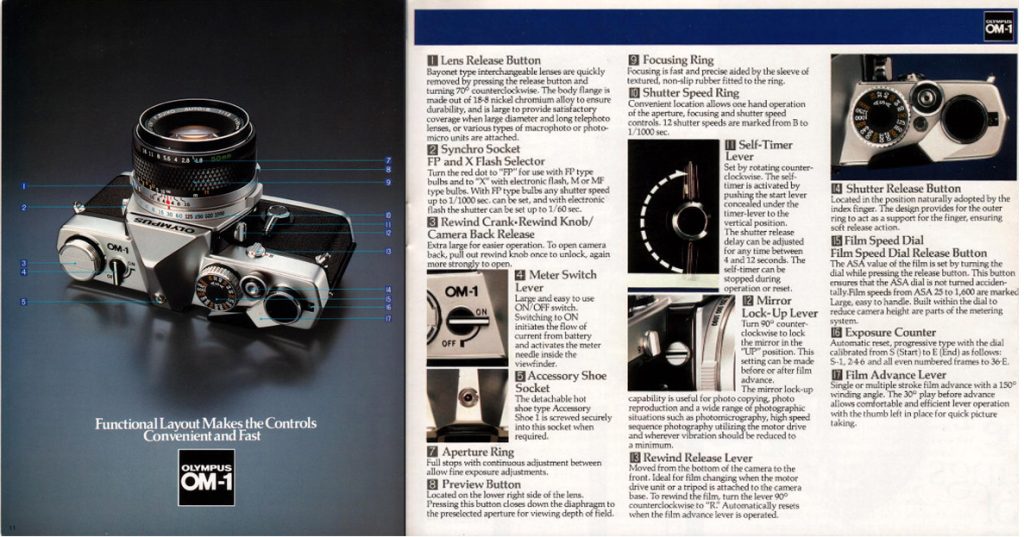
The Olympus OM-1 is at its best when treated as a fully manual instrument: simple, quiet, precise, and capable of beautiful results in any light.
This chapter is a practical walk-through of how to handle the camera the way it was designed to be used.
Everything below is built around real-world shooting-street, travel, portraits, landscapes, and everyday photography.
A. The OM-1 Handling Philosophy: Hands on the Lens
The OM-1 is unusual among SLRs because:
Shutter speeds are around the lens mount, not on the top plate.
Aperture, shutter, and focus all sit under the left hand.
The right hand only advances film and presses the shutter.
This creates a shooting rhythm where all exposure decisions happen without lowering the camera.
The viewfinder stays to the eye.
The scene stays uninterrupted.
The photographer stays connected.
This is the heart of the OM shooting experience.
B. Setting Exposure: The Three Quick Methods
The OM-1 meter is centre-weighted, responsive, and predictable once understood.
There are three reliable ways to expose confidently.
1. The Classic Needle Match
The shutter-speed ring and aperture ring are visible without taking the camera from your eye.
Process:
- Half-press shutter, needle activates
- Turn shutter-speed ring, needle moves
- Adjust aperture, needle compensates
- Align needle to the centre mark
This is the traditional approach and works perfectly in consistent lighting.
2. The Two-Point Check (The More Accurate Method)
For high-contrast scenes:
- Meter the brightest important highlight.
- Meter the deepest shadow you want detail in.
- Choose exposure that preserves both.
This avoids losing detail in harsh sun or night scenes.
3. Set-and-Forget Outdoors (The Fastest Method)
Because the OM-1 is mechanical and predictable, a set of fixed exposure rules eliminates constant adjustments:
In full sun:
- ISO 400 film: 1/500 at f/11
- ISO 200 film: 1/250 at f/11
- ISO 100 film: 1/125 at f/11
(Sunny 16 + OM-1 variations)
From there:
- Open 1 stop for slight cloud
- Open 2 stops for shade
- Open 3 stops indoors or golden hour
The meter becomes a confirmation tool, not the only tool.
C. Focusing the OM-1: Getting Consistently Sharp Images
The OM-1 viewfinder is enormous and bright, but accuracy depends on choosing the right focusing method.
1. The Microprism Spot
The microprism centre shows shimmering when out of focus.
Turn the focusing ring until the shimmering disappears.
Best for:
- Street
- Portraits
- General daytime shooting
2. The Split-Prism Rangefinder (if fitted)
Some screens show a horizontal split.
Align both halves of a subject and focus snaps perfectly.
Best for:
- Architecture
- Straight edges
- People at mid-distance
3. Matte Screen Surround
The plain matte area around the centre is excellent for:
- Low light
- Wide apertures
- Subjects without strong lines
This part of the screen shows focus transitions more smoothly than the microprism.
D. The OM-1 Shutter: What Each Speed Is Actually For
One of the most helpful parts of OM-1 mastery is understanding what the shutter speeds actually mean in practice.
1/1000 – Bright sun, action, shallow depth with fast films
1/500 – Outdoor portraits, street, telephoto work
1/250 – Everyday daylight baseline
1/125 – Walk-around speed, people in shade
1/60 – Indoors with ISO 400, careful hand-holding
1/30 – Still subjects, brace yourself
1/15 – Dramatic blur, night street, handheld only with experience
1/8 – 1s – Tripod territory
Understanding these speeds transforms handling-especially when paired with fast Zuiko lenses.
E. Lens Handling: Aperture Strategy for Zuiko Rendering
Zuiko lenses have distinct personalities depending on aperture.
These guidelines apply to most primes:
Wide open (f/1.4-f/2):
Dreamy, soft highlight transitions, beautiful for portraits and street at night.
f/2.8-f/4:
Peak character zone.
Micro-contrast increases, edges sharpen, flare control improves.
f/5.6-f/8:
Maximum sharpness and clarity.
Ideal for landscapes, travel, and documentary work.
f/11-f/16:
High depth-of-field, small diffraction loss.
Works well for architecture and environmental scenes.
The OM-1 rewards aperture planning-choose the look before raising the camera.
Portrait Work
One limitation of the OM-1 is the maximum shutter speed of 1/1000s, which makes wide-aperture portraits difficult in bright sunlight. A simple, reliable workaround is to use a 3-stop ND (ND8) filter. This reduces the incoming light enough to keep lenses like the 50mm f/1.4 or 85mm f/2 wide open even at midday, preserving shallow depth of field and protecting highlights.
It turns harsh daylight into workable portrait light:
- smoother skin tones
- controlled highlights
- background separation even at noon
- full creative use of fast Zuiko primes
It’s one of the most useful small accessories an OM portrait shooter can carry.
F. Meterless Shooting: The OM-1’s Secret Strength
Because the shutter is fully mechanical, the camera remains 100% functional even if:
- the battery dies
- the meter drifts
- cold weather reduces voltage
The OM-1 becomes a pure manual machine.
Two simple methods cover almost all lighting:
1. Sunny 16 Rule
Reliable for daytime.
2. Exposure Triangle Memory
For ISO 400:
- Indoors with window light: 1/60 at f/2.8
- Overcast outdoors: 1/125 at f/5.6
- Bright sun: 1/500 at f/11
After a few rolls, exposure becomes instinctive.
G. Techniques That Make the OM-1 Shine
These are practical methods that suit the camera’s design perfectly.
1. The OM Pre-Focus Method
Set distance to:
- 1.5m for street
- 3m for travel
- Infinity for landscapes
Raise camera, shoot instantly, zero delay.
The viewfinder is bright enough to confirm instantly if focus needs a small correction.
2. The OM Steady Grip
Because the shutter-speed ring sits around the lens, the left hand naturally supports most of the weight.
This allows:
- Slower shutter speeds than most SLRs
- Reduced vibration
- More stable framing
The air-dampened mirror helps further.
3. Hyperfocal Focusing
Perfect for landscapes and seascapes.
Example for a 28mm lens at f/8:
- Set the mark to the right f/8 line
- Everything from ~1.5m to infinity becomes sharp
The OM-1 excels at this technique because of its clear depth-of-field scales.
4. Using Mirror Lock-Up for Maximum Sharpness
Activate via the self-timer lever.
Best used for:
- Macro
- Telephoto work
- Long exposure landscapes
- Night photography
This reduces vibration at the most critical moment.
H. Shooting Film with Confidence
The OM-1 pairs especially well with films that benefit from manual control and clean rendering:
Black & White
- Ilford HP5, forgiving and flexible
- Kodak Tri-X, punch, presence, contrast
- Ilford FP4, beautiful mid-tones
Colour
- Kodak Gold, classic warmth
- Portra 160, gentle skin tones
- Ektar 100, landscapes and travel
Underexposing colour film by ½ stop often gives richer tone and deeper colour-especially with Gold and Portra.
I. When the OM-1 Outperforms Modern Cameras
There are situations where the OM-1 delivers results even high-end digital struggles with:
- Shadow detail in B&W films
- Natural colour under harsh midday sun
- Long exposures without heat noise
- Pure manual control for storytelling projects
- Silent, vibration-free hand-held night shooting
Its simplicity is its strength.
If you only remember one thing:
The OM-1 rewards preparation.
Set your exposure rhythm, choose your aperture for the look you want, and let the camera disappear in your hands.
Do that, and the OM-1 becomes one of the most intuitive film cameras ever made.
Common Myths About the OM-1
Separating fact from folklore
Decades of forum posts, half-remembered anecdotes, and nostalgia have created a long list of myths about the OM-1 – some harmless, some misleading, and some that unnecessarily scare new users away from brilliant cameras.
This chapter clears the air.
Myth 1 – The OM-1 meter doesn’t work with modern batteries.
Truth:
The meter does work. It simply requires the correct voltage.
The OM-1 was designed for 1.35v mercury cells.
Using a 1.5v alkaline battery without adjustment causes over-metering by ~1 stop.
Three perfectly functional solutions exist:
- Zinc-air 1.35v (Wein) – exact match
- MR-9 adapter – converts modern cells to 1.35v
- Manual compensation – workable once you understand the drift
The camera is fully operational even if the battery dies – the shutter is 100% mechanical.
Myth 2 – The OM-1 is unreliable because it’s old.
Truth:
Neglect is unreliable – the OM-1 is not.
A serviced OM-1 is one of the most dependable mechanical SLRs ever made.
Most problems found today come from bodies that have gone 40-50 years without maintenance.
Once serviced, they run smoothly for another decade or more.
Myth 3 – The OM-1 viewfinder always has prism rot.
Truth:
Not always – and when it does, it’s repairable.
Prism rot is caused by the original foam deteriorating.
It’s common, but not universal, and it’s fixable by any experienced OM technician.
A clean OM-1 viewfinder is one of the best in all film photography – large, bright, uncluttered.
Myth 4 – The OM-1 can’t shoot in bright sun because it only goes to 1/1000.
Truth:
It can – with technique.
Midday portraits wide open at f/1.4 are difficult because of bright light, not because of the shutter.
One simple tool solves it:
a 3-stop ND (ND8) filter.
It brings shutter speeds back into range, preserves shallow depth of field, and protects highlights.
Landscape shooters rarely hit the limit anyway – f/8 or f/11 handles daylight perfectly.
Myth 5 – Olympus lenses are soft wide open.
Truth:
Some are character lenses, not soft lenses.
Zuiko rendering intentionally prioritises:
- smooth transitions
- controlled highlights
- gentle contrast
The silver-nose 50/1.4 is meant to glow at f/1.4.
The late-version 50/1.4 and 50/1.8 MIJ are extremely sharp by f/2.8.
The OM system has both character lenses and technical lenses – each used for different aesthetics.
Myth 6 – Only the early OM-1 bodies are worth buying.
Truth:
Later bodies (especially OM-1 MD and OM-1N) are often the best choice.
Reasons:
- better film advance refinements
- motor-drive compatibility
- improved meter stability
- easier servicing
- fewer decades of wear on average
The early M-1 models are historically special, but not inherently better for shooting.
Myth 7 – The OM-1 is too small for serious work.
Truth:
Its size is the design advantage.
The compactness is deliberate – part of Maitani’s core philosophy:
- lighter, more mobility
- smaller, less fatigue
- quieter, more discreet
- simpler, faster operation
It became the foundation of every OM camera that followed.
The size is not a limitation. It’s the point.
Myth 8 – The OM-1 has bad flash performance.
Truth:
It has classic flash performance – identical to most 1970s SLRs.
1/60s sync is standard for the era.
In practice:
- bounce flash works beautifully
- studio strobes sync without issue
- fill flash outdoors is clean and predictable
The OM-2 introduced TTL brilliance, but the OM-1 remains perfectly usable with flash.
Myth 9 – The OM-1 meter is inaccurate.
Truth:
When serviced and using correct voltage, the meter is consistently reliable.
Centre-weighted, responsive, and predictable – especially when paired with:
- negative film latitude
- stable battery voltage
- proper exposure technique
What fails over time isn’t the design – it’s the 50-year-old circuitry needing fresh calibration.
Myth 10 – Film is too slow for modern photography.
Truth:
The OM-1 is not a fast-paced sports camera – but it’s extraordinary for everything else.
Its strengths are:
- portraits
- street
- travel
- landscapes
- documentary
- creative projects
- long exposure work
- environmental storytelling
The OM-1 isn’t about speed.
It’s about intention.
And intention is timeless.
Myth 11 – Modern digital lenses outresolve Zuikos.
Truth:
Resolution alone doesn’t define the image.
Film rendering comes from:
- tonal transitions
- halation
- grain structure
- micro-contrast
- flare behaviour
- colour response
- lens coatings
- optical character
Zuikos are not competing with digital glass – they offer a different, more organic way of seeing.
Myth 12 – You need lots of lenses to use the OM-1 effectively.
Truth:
Most OM shooters settle naturally into three focal lengths.
Maitani designed the system around:
- one wide
- one normal
- one short telephoto
Carrying fewer lenses means:
- faster shooting
- lighter bags
- clearer creative intention
The OM-1 thrives when kept simple.
Myth 13 – You need experience to use an OM-1
Truth:
The OM-1 is one of the friendliest manual cameras ever made.
Everything is tactile.
Everything is visible.
Everything behaves logically.
It teaches exposure in a way digital cameras cannot.
Beginners find it intuitive.
Experienced photographers find it liberating.
If you only remember one thing:
Most OM-1 issues aren’t defects – they’re age.
A clean finder, fresh battery, and new light seals solve almost everything people complain about online.
The OM-1 in the Real World
What it’s actually like to live with Olympus’s mechanical masterpiece
For all the specifications, engineering notes, and historical significance, the real magic of the OM-1 only appears when you take it out into the world – when it hangs from your shoulder, when it becomes part of your routine, when the weight and shape and sound of it begin to feel familiar.
The best cameras don’t just take pictures.
They change behaviour.
They shape the way their owners move through the world.
The OM-1 is one of those cameras.
A. The OM-1 on the Street: Quiet, Unobtrusive, Instant
The first thing most people notice is how quiet it is.
Not silent – but discreet.
A soft, confident mechanical click that doesn’t turn heads or break moments.
It’s the kind of shutter sound that feels trustworthy.
You press it and immediately know something real just happened.
On the street, the size and weight make a difference too:
- It doesn’t intimidate subjects.
- It doesn’t pull your neck down.
- It doesn’t drag your attention away from what’s happening around you.
The OM-1 is a camera that disappears – and that invisibility is a strength.
It gives you the freedom to react.
To move quickly.
To work intuitively.
B. The OM-1 for Travel: A Camera That Encourages Curiosity
There’s a certain type of camera that feels like a companion – not a piece of equipment – and the OM-1 fits that category perfectly.
Slip it into a bag with a single prime lens and it becomes:
- a journal
- a sketchbook
- a memory machine
- a reason to wander down side streets
Travel slows down when using the OM-1.
Not because the camera is slow, but because the process is mindful.
You’re not constantly checking the back of a screen.
You’re not chimping.
You’re not drowning in settings or menus.
You’re simply looking.
Really looking.
And that is the true purpose of a travel camera.
C. The OM-1 for Portraits: Intimacy Through Simplicity
The OM-1 doesn’t put anything between the photographer and the subject.
There are no autofocus beeps, no digital overlays, no distractions.
Just a bright finder, a simple meter, and a quiet shutter.
People relax faster when photographed with an OM-1.
It feels less like machinery pointed at them and more like a conversation with a purpose.
Paired with lenses like the 50mm f/1.4 or 85mm f/2, the OM-1 becomes a portrait tool that captures:
- softness without blur
- clarity without harshness
- character without exaggeration
It has a way of making people look the way they feel – not the way a sensor insists they should.
D. The OM-1 for Landscapes: Pure Observation
Walk into an open landscape with an OM-1 and something interesting happens.
The camera stops feeling like gear.
It becomes an anchor – something that grounds you in the scene.
Wide Zuiko primes paired with the OM-1’s enormous finder turn distant horizons into clean, deliberate compositions.
The mechanical shutter, free of electronic lag, makes long exposures feel natural.
And because the camera weighs so little, it never becomes a burden on a long walk.
This is why landscape photographers still carry OM-1 bodies decades after digital took over – not out of nostalgia, but because the experience itself is clearer, calmer, and more meaningful.
E. The OM-1 for Daily Life: A Camera That Always Wants to Come Along
Many cameras are great to use – but few make you want to take them everywhere.
The OM-1 does exactly that.
It’s small enough to live in a bag without thought.
It’s light enough to carry all day without fatigue.
It’s reliable enough that you trust it won’t fail.
And importantly:
It makes ordinary days feel worth photographing.
Trips to the shop.
Train rides.
Walks at dusk.
Quiet moments at home.
With the OM-1, everything becomes potentially meaningful because the barrier to taking a photograph is so low and the reward is so high.
F. The OM-1’s Real Strength: Presence
Some cameras make you think like an engineer.
Some make you think like a collector.
Some make you think like a technician.
The OM-1 makes you think like a photographer.
Its entire design encourages presence:
- present with your subject
- present with the light
- present with the scene
- present with the moment
This is what makes the OM-1 timeless.
Not the specs.
Not the nostalgia.
Not the reputation.
It’s the way it makes people look at the world.
G. The OM-1 Today: Why It Still Belongs in 2026
The OM-1 doesn’t feel outdated in use.
If anything, it feels surprisingly modern because:
- the controls are intuitive
- the viewfinder is enormous
- the ergonomics are thoughtful
- the images have an honesty digital often struggles to match
In a world of constant upgrades, software updates, and feature lists, the OM-1 feels refreshing because it doesn’t need anything added.
It’s complete.
Finished.
Resolved.
A tool built not to impress a spec sheet, but to serve a craft.
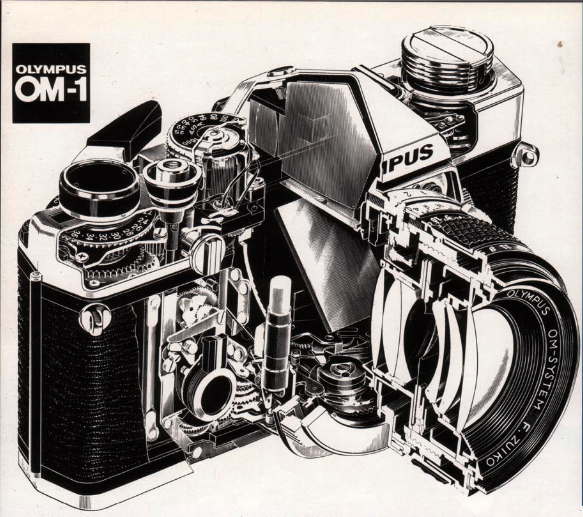
H. The Real Verdict
The OM-1 isn’t perfect – no camera is.
But it is one of the most perfectly balanced cameras ever made.
If a camera can be called a companion, the OM-1 qualifies.
Not because it gets out of the way, but because it gets into the way – the right way – helping you see more clearly, slow down slightly, and pay attention to the things that usually slip past.
The OM-1 is not just a camera you use.
It’s a camera you live with.
And that’s why, half a century after its release, photographers are still reaching for it, still shooting with it, still discovering new ways it fits their lives.
Closing Notes
The Olympus OM-1 has a way of staying with anyone who spends time with it.
It’s a simple camera, but never a limiting one.
A mechanical object, but never a cold one.
A piece of history, but still entirely alive in the hands of anyone willing to slow down and really look.
If this guide has helped deepen understanding of the OM-1 – its design, its handling, its strengths, its quirks – then it has done its job.
The camera deserves a resource that treats it with the same care that went into its creation.
The OM-1 has earned its place not because it is old, but because it is right.
Right in the hand, right to the eye, right in the way it encourages a photographer to think and move and notice.
It offers a way of working that remains as relevant now as it was the day it left the factory.
If you found this guide helpful, consider sharing it with others who might appreciate the OM-1.
The more people who discover what this camera can do, the more the legacy of Maitania’s design continues exactly where it belongs: in real use, in real hands, making real photographs.
If you’re planning to build a complete OM system around the OM-1 – lenses, bodies, film choices and accessories – the Ultimate OM Kit Builder walks through every decision step by step.
For those who want to continue exploring:
Looking for technical specifications, serial guides, and historical documents?
A dedicated Technical OM-1 Reference Guide is available, covering:
- full specs for OM-1, OM-1 MD, OM-1N
- serial number ranges and production eras
- detailed feature evolution
- key mechanical differences
- repair notes and compatibility charts
It complements this article by focusing strictly on data, engineering, and collector information.
OM-1 Manuals, Brochures & Original Literature
Scans of historical documents – including brochures, manuals, and Olympus marketing material – are available to download directly below.
They remain the clearest window into how the camera was presented in its own era.
- Olympus M Original Brochure, 1972 (PDF)
- Olympus OM-1 Brochure, 1976 (PDF)
- Olympus OM-1 and OM-2 Brochure, 1978 (PDF)
- Olympus OM-1 MD Brochure, 1983 (PDF)
- Olympus OM-1 User Manual (PDF)
- Olympus OM-1 MD User Manual (PDF)
- Olympus OM-1N User Manual (PDF)
Original manuals, brochures, and historic OM documentation are preserved in the Olympus OM Archive.
All documents are shared here as historical references for educational use only. Copyright remains with the original creators. No commercial use is intended, and no profit is made from their inclusion on Zuikography.