
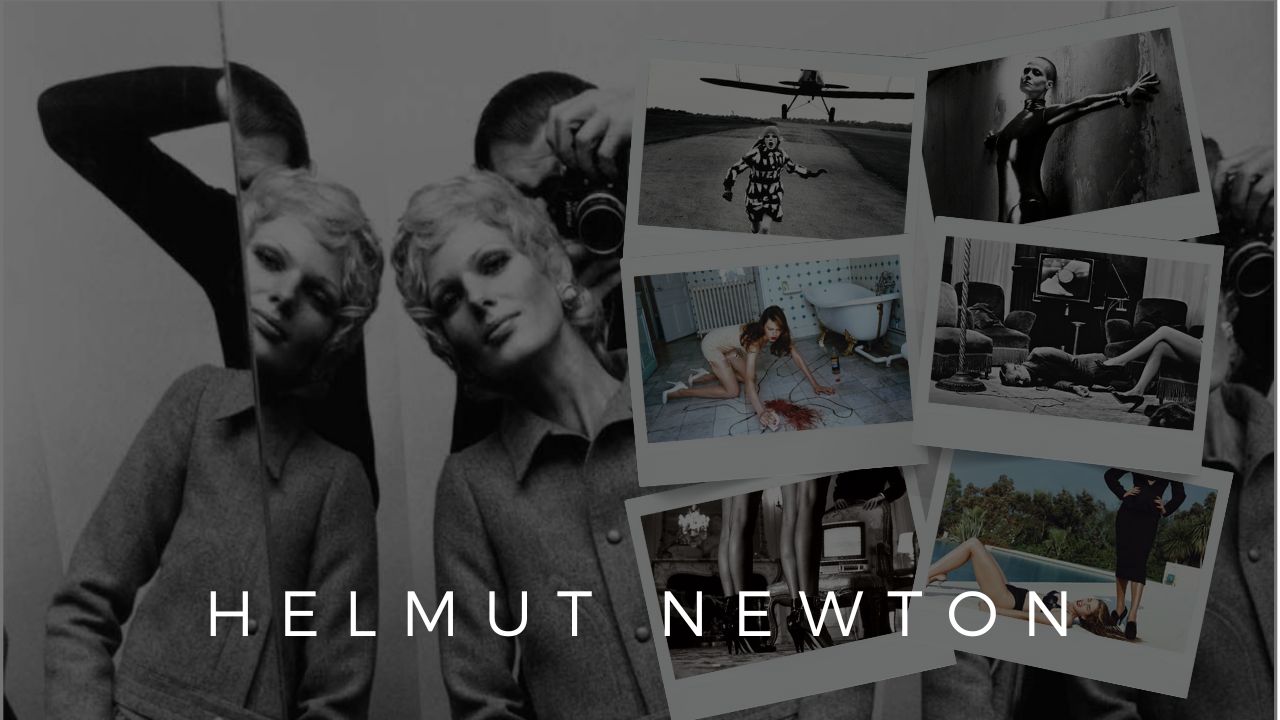
Helmut Newton never hesitated.
His portraits looked straight back – cool, self-possessed, and often half-dressed. He photographed women with force, desire with geometry, and fashion with a kind of playful danger that has never been matched. Newton didn’t follow the rules of commercial photography; he quietly dismantled them, then rebuilt them on his own terms.
Today, he’s remembered for the big tools: Hasselblads, Rolleiflexes, and the sculptural square frames they produced. But Newton was never tied to a single system. He used whatever camera gave him speed and clarity in the moment – Nikons, Pentaxes, Konicas, Leicas, and yes, Olympus.
He preferred simplicity:
a familiar 50mm view, one body, one lens, and an idea worth chasing.
The equipment was never the complicated part.
His mind was.
Which is where the OM slips into view.
I use what God gives me, but I arrange the world the way I like it.
The Helmut Look
Born in Berlin in 1920, Newton trained under Yva before fleeing Germany in 1938. From Australia to Paris, Monte Carlo, and Los Angeles, he built a career defined by bold lighting, unapologetic framing, and a sense of narrative tension that felt more cinematic than editorial.
His trademarks were unmistakable:
- High contrast
- Deep, deliberate shadows
- Flash-lit hallways, rooftops, alleys, and car parks
- Women who looked powerful rather than posed
His photographs often read like a scene unfolding just before – or just after – something has happened. They were never passive. They held stories.
My photos are like stories that have no beginning, no middle and no end.
Speed Over Ceremony: The Olympus OM Era
Newton’s love of medium format didn’t stop him from grabbing a smaller camera when he needed to move quickly. Throughout the 1970s and 80s, the Olympus OM-1 and OM-2 were regulars in his hands – not for prestige, but for practicality.
They allowed him to work fast, quietly, and without the theatre of assistants and lighting rigs. He used them for:
- Quick test exposures
- Fast-paced street sessions
- Spontaneous fashion in Monte Carlo and LA
- Behind-the-scenes glimpses of shoots and daily life
And in his later years, he often carried the Olympus Mju II (Stylus Epic) – a camera that looked like nothing special until you saw what he did with it. The compact went everywhere: hotel balconies, sunlit pavements, private moments with June, and the edges of the world between assignments.
The OM wasn’t his signature system.
It was his escape hatch – the tool that let him think with his feet.
Geometry, Shadows, and the Mind Behind the Lens
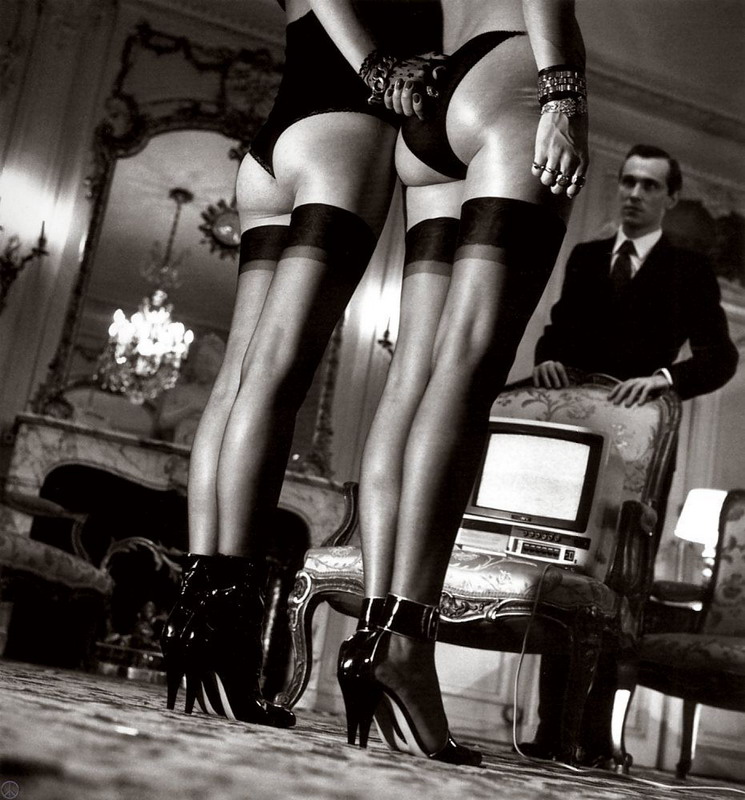
Newton’s images were glamorous, erotic, and often confrontational, but beneath everything sat structure. He loved diagonals, reflections, and architectural lines. His shadows weren’t accidents; they were characters. His light wasn’t decoration; it was the engine of the story.
This precision is exactly what makes his 35mm work so compelling.
With a small camera – whether Olympus, Nikon, or anything else – Newton still composed like Newton.
The OM system, with its sharp Zuiko primes and stripped-down controls, suited that mentality. No clutter. No ceremony. Just the frame.
He proved that you didn’t need 15 bags of equipment to make a photograph that mattered.
You needed intuition, clarity, and a willingness to push the moment.
I always kept my equipment down to a minimum of two cameras, each with three lenses, a flash that would clip onto the camera body, and one assistant. I did not want to spend time thinking about hardware; I wanted that time to concentrate on the girl and the world around her.
Legacy: Why He Belongs in the Hall of OM
Helmut Newton died in 2004 at the age of 83, still making work, still refining his archive, still telling stories through light and shadow.
His legacy lives in monographs like White Women, Big Nudes, World Without Men, and Sumo – but also in the countless photographers who realised, through him, that a small camera can be just as dangerous as a big one.
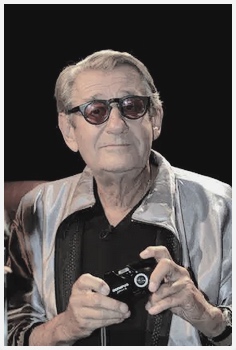
He earns his place here not because he was an Olympus loyalist – he wasn’t – but because he showed the world what a small 35mm camera could achieve at the highest level.
The OM didn’t soften his edge.
It sharpened his speed.
And sometimes, that was everything.