
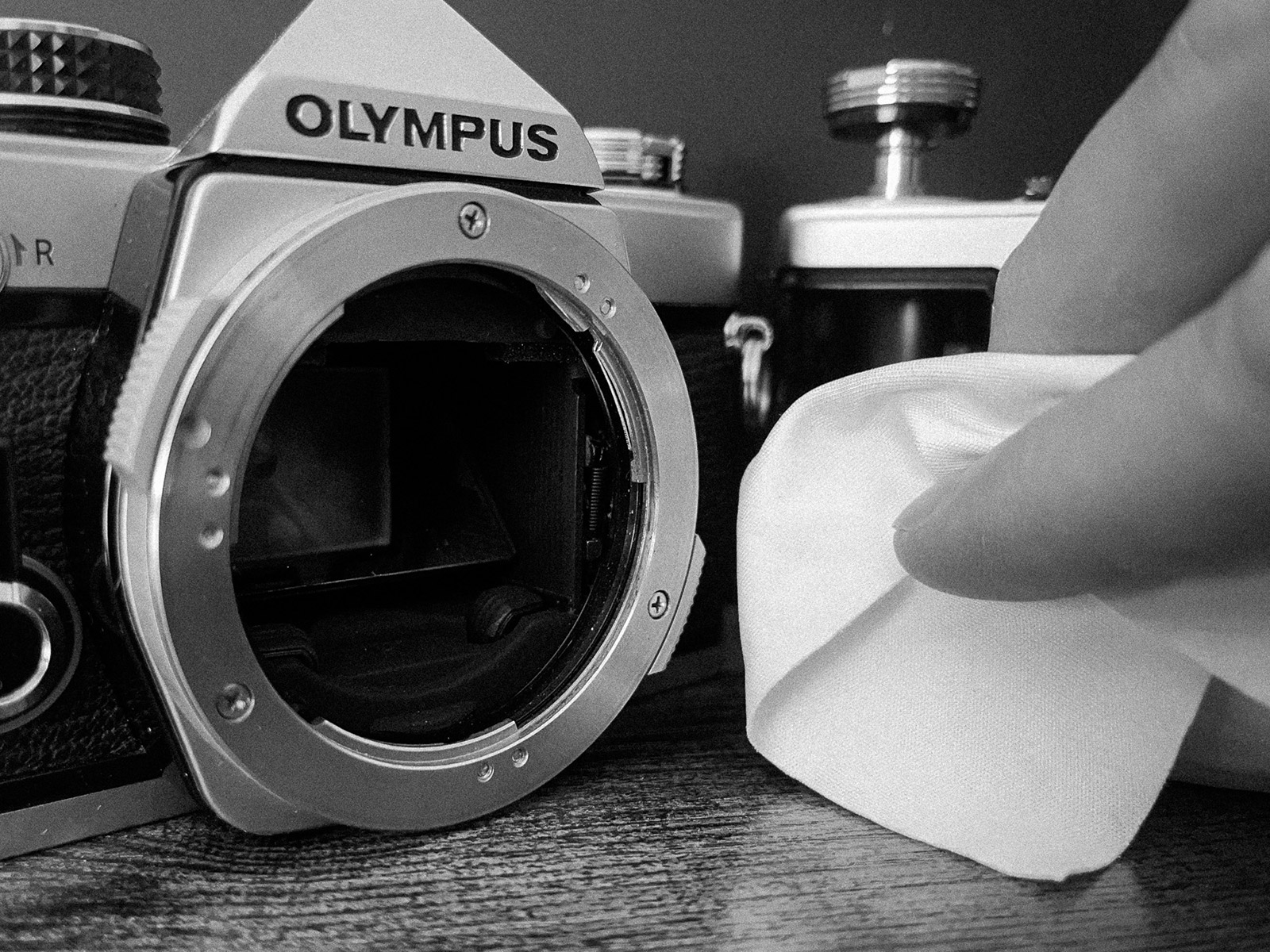
(Even If Every Instinct Tells You To)
Olympus OM cameras are famously tough. Mechanical, compact, beautifully engineered, and still shooting happily forty-plus years after they left the factory. That toughness is deceptive.
Because while most of an OM body will tolerate decades of use, dust, knocks, and the occasional questionable life choice, there are a few parts that look innocent, obvious, even cleanable… and absolutely are not.
If you’re new to OM cameras, or you’ve just started tinkering, this article exists to save you from at least one unnecessary oh sh*t moment.
Ask me how I know.
The Mirror (Why You Should Never Clean It)
Do not clean it. Ever.
Yes, it’s a mirror.
No, it is not like a normal mirror.
OM mirrors are front-surface coated, meaning the reflective layer sits on top of the glass, not behind it. There’s no protective layer. No margin for error.
What this means in practice:
- Lens wipes will streak it
- Microfibre cloths will thin the coating
- Repeated cleaning will permanently damage it
If you see:
- black dots
- dull patches
- faint streaks
They are almost always coating deterioration, not dirt.
Important reality check:
- The mirror has no effect on your photos
- It flips up before exposure
- It only affects what you see while composing
If dust won’t move with a blower, leave it alone.
If it bothers you visually one day, that’s a mirror replacement, not a cleaning job.
Focusing Screens (What Not to Do)
If it’s not dust, it’s not coming off.
OM focusing screens are precision optical components. They are:
- extremely soft
- easily scratched
- very easy to ruin accidentally
What not to do:
- no cloths
- no wipes
- no fluids
- no cotton buds
- no just a gentle polish
What to do:
- a hand blower only
- light, indirect air
- nothing else
Marks that don’t move are usually:
- factory defects
- age-related deterioration
- coating wear
And again:
If you don’t see it during normal composition, it does not matter.
Meter Cells and Prisms (Do Not Touch)
They are not windows.
The OMs metering system relies on light passing through very specific optical paths. Touching, wiping, or cleaning, anything near the prism or meter cell window is a fast way to create:
- haze
- smearing
- inaccurate readings
If a meter is inaccurate:
- it’s electrical
- or age-related
- or calibration-related
It is almost never dirty.
Shutter Curtains (Hands Off)
Just… don’t.
If you can see the shutter curtains:
- don’t touch them
- don’t brush them
- don’t blow air directly at them
They are thin, tensioned, and unforgiving. Finger oils alone can cause problems over time.
If they look uneven, slow, or damaged:
- that’s a service issue
- not a cleaning issue
Internal Foam (Unless You’re Replacing It Properly)
Poking degraded foam is worse than leaving it.
Old OM foam can:
- crumble
- smear
- migrate into places it shouldn’t be
Half-removing foam without replacing it properly often causes more mess than leaving it intact until you’re ready to do the job properly.
If you’re not replacing seals:
- leave them alone
- don’t scrape, just a bit
- don’t vacuum them out
What Is Safe to Clean on an Olympus OM Camera
OM cameras aren’t made of glass nerves. Plenty is safe:
- exterior leatherette
- top and bottom plates
- lens mounts (carefully)
- rewind knobs
- wind levers
- lens barrels and glass (properly)
The trick is knowing the red-line parts. Once you do, OM cameras are wonderfully robust.
The Real Lesson
Most OM damage doesn’t come from abuse.
It comes from care.
From wanting things clean.
From wanting things right.
From assuming something that looks simple must be simple.
Every long-term OM user has one moment where they learn this the hard way. Consider this article the shortcut.
If you take one thing away, make it this:
If it doesn’t affect the photograph, think very hard before touching it.
Your OM will thank you by quietly working for another few decades.