
In 1972, Olympus didn’t just launch another SLR.
They launched a revolution.
The OM-1 wasn’t bigger, heavier, or louder than its rivals.
It was the opposite: smaller, lighter, quieter, sharper and it changed how serious photographers approached their craft.

Half a century later, its influence is everywhere.
A Radical Vision: Maitani’s Mission
Yoshihisa Maitani believed that a photographer’s camera should be an extension of their body, not a burden.
At a time when professional SLRs were growing into metal bricks, Maitani and his team stripped everything down:
- Smaller body.
- Lighter frame.
- Smoother operation.
- More intuitive controls.
The result was the original M-1 renamed OM-1 after Leica objected, a machine that made every photographer who touched it reconsider what an SLR could be.
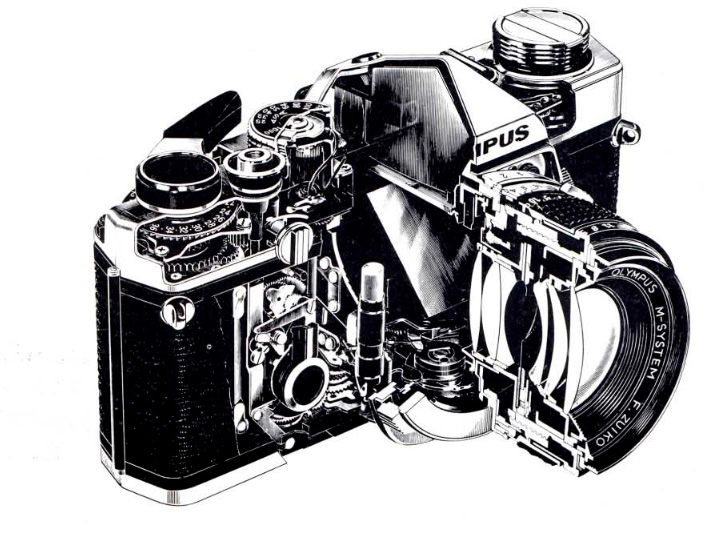
Core Features That Set the Standard
- Fully Mechanical Shutter:
The OM-1 operates entirely without electronics.
Only the light meter requires a battery, the rest is pure mechanical precision. - Massive Viewfinder:
One of the largest viewfinders ever fitted to a 35mm SLR, offering ~97% frame coverage.
Bright, clean, and uncluttered. - Lens-Mounted Shutter Speed Ring:
Unlike other SLRs, shutter speeds are set around the lens mount, keeping adjustments fast and natural without moving your eye from the viewfinder. - Air-Dampened Mirror:
Reduces vibration and noise, making hand-held shooting sharper and stealthier. - Self-Timer and Mirror Lock-Up:
Integrated into one control for reducing vibration in long exposures and macro photography. - Durable, Compact Body:
Weighing just over 500g, the OM-1 set a new benchmark for lightweight professional design. - Flash Support:
X-sync at 1/60s for external flash units. Compatible with Olympus T-series and F-series flashes.
From OM-1 to OM-1 MD: What Changed
By 1974, Olympus engineers recognised that motor drives were becoming essential for sports, reportage, and professional studio work.
The original OM-1 could accept a motor drive, but only with a costly, permanent factory modification.
Thus, Olympus introduced the OM-1 MD.
- MD = Motor Drive Ready:
Pre-fitted with a removable cover plate for direct attachment of the Motor Drive, no modifications needed. - Markings:
Early OM-1 MD bodies had small MD engravings near the rewind knob. Later ones made it more prominent.
Important:
Beyond the motor drive compatibility, the OM-1 MD is mechanically and operationally identical to the standard OM-1.
The Final Evolution: OM-1N
In 1979, Olympus released the OM-1N
a refined OM-1 MD with minor but meaningful updates:
- Flash Ready Light:
A small LED in the viewfinder confirms flash charge when using Olympus T-series flashes. - Improved Shutter Speed Dial:
Smoother operation with slightly better click stops. - Revised Film Advance Mechanism:
Smoother feel, longer-term reliability. - Slight Metering Updates:
More stable voltage tolerance for 1.5V batteries (but still officially a 1.35V design).
Otherwise, the shooting experience remains true to Maitani’s original vision:
compact, tactile, mechanical mastery.
How to Estimate the Age of Your OM-1
While Olympus didn’t publish exact serial production lists, years of repair data and collector research have provided reliable estimates:
| Serial Number Range | Model | Approximate Production Years |
|---|---|---|
| 100000-199999 | Early OM-1 / M-1 | 1972-1973 |
| 200000-499999 | OM-1 | 1973-1974 |
| 500000-699999 | OM-1 MD | 1974-1977 |
| 700000-899999 | OM-1 MD / Early OM-1N | 1977-1979 |
| 900000+ | OM-1N | 1979-1987 |
Where to find it:
- Look for the serial number on the top plate, usually next to the rewind crank.
Notes:
- Early “M-1” cameras are typically under #200,000.
- OM-1 MD models cluster around the 500,000 range and upward.
- OM-1N bodies tend to start from the 900,000s, but overlap slightly depending on production batch.
Every OM-1 family body carries the same mechanical soul — but spotting an early M-1 or a high-number OM-1N adds a little extra story to your camera.
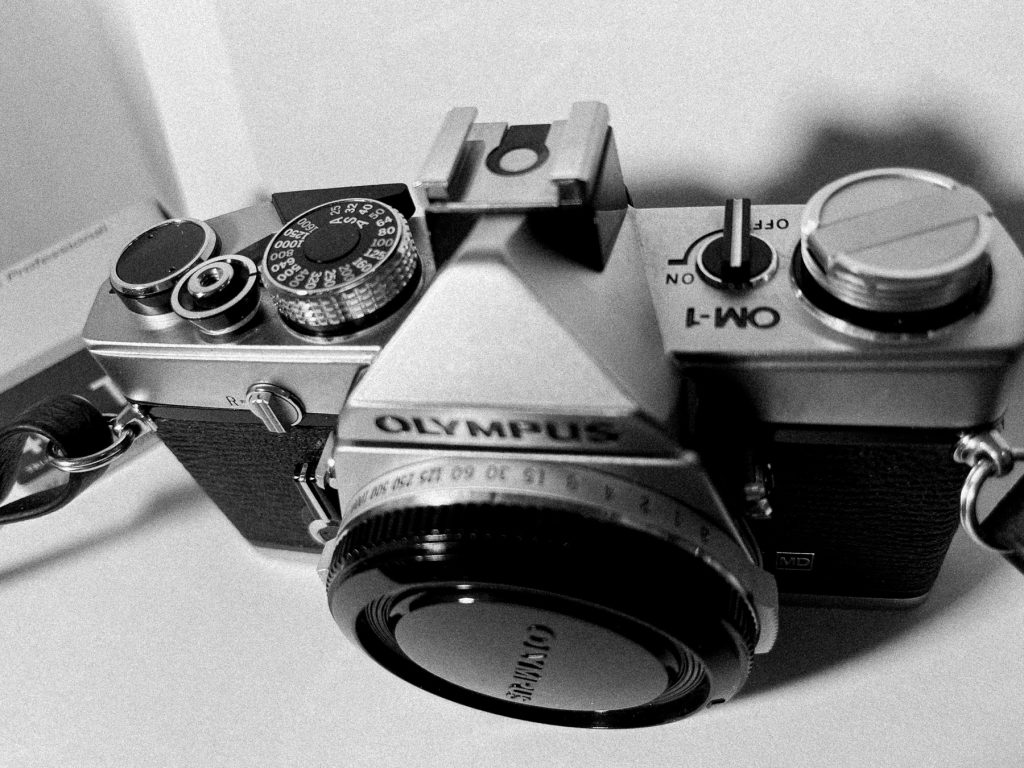
Olympus OM-1 Family: Key Differences Summary
| Model | Main Features | Notes |
|---|---|---|
| OM-1 | Original release, mechanical shutter, battery-dependent light meter | Requires modification for motor drive |
| OM-1 MD | Same as OM-1, but motor drive ready from the factory | MD plate added |
| OM-1N | Motor drive ready, flash ready light, smoother controls | Slight voltage improvements |
Olympus OM-1: Full Specifications
| Specification | Detail |
|---|---|
| Year Released | 1972 (OM-1), 1974 (OM-1 MD), 1979 (OM-1N) |
| Shutter Speeds | 1s-1/1000s, Bulb |
| Flash Sync | 1/60s (X-sync) |
| Viewfinder Coverage | ~97% |
| Metering | Centre-weighted (battery-dependent) |
| Weight | Approx. 510g (body only) |
| Motor Drive Compatibility | Factory-ready from OM-1 MD onward |
| Mirror Lock-Up | Via self-timer lever |
| Build Material | Magnesium alloy frame |
Brochures and Manuals for Download
- Olympus M Original Brochure, 1972 (PDF)
- Olympus OM-1 Brochure, 1976 (PDF)
- Olympus OM-1 and OM-2 Brochure, 1978 (PDF)
- Olympus OM-1 MD Brochure, 1983 (PDF)
- Olympus OM-1 User Manual (PDF)
- Olympus OM-1 MD User Manual (PDF)
- Olympus OM-1N User Manual (PDF)
All documents are shared here as historical references for educational use only. Copyright remains with the original creators. No commercial use is intended, and no profit is made from their inclusion on Zuikography.
Final Word
The Olympus OM-1 and its descendants, the OM-1 MD and OM-1N weren’t just smaller or lighter.
They were smarter.
They respected the photographer’s craft instead of complicating it.
Load a roll.
Trust your hands.
Create photographs with a machine that was – and still is – built for the real work of seeing.