
When Olympus launched the OM-1 in 1972, they redefined what a professional SLR could be: smaller, lighter, more agile.
But Maitani and his team weren’t finished.
Three years later, in 1975, they released the Olympus OM-2 – combining everything photographers loved about the OM-1 with a breakthrough in exposure technology.
And in 1979, they perfected it further with the OM-2N.

This is the story of how Olympus quietly built two of the most intelligent, intuitive film cameras ever made.
The Big Leap: Off-the-Film (OTF) Metering
The OM-2 introduced something no other camera had:
Off-the-Film (OTF) Auto Metering.
Instead of measuring light through the lens before you took a photo, the OM-2 measured light off the shutter curtain (for short exposures) or directly off the film surface (for long exposures)
during the actual exposure itself.
Olympus called it Auto Dynamic Metering (ADM).
The world simply called it a revolution.
Result?
- You could shoot at night, on stage, in impossible conditions and trust the exposure.
- You could confidently leave the light meter at home.
- You could think less about settings, and more about photographs.
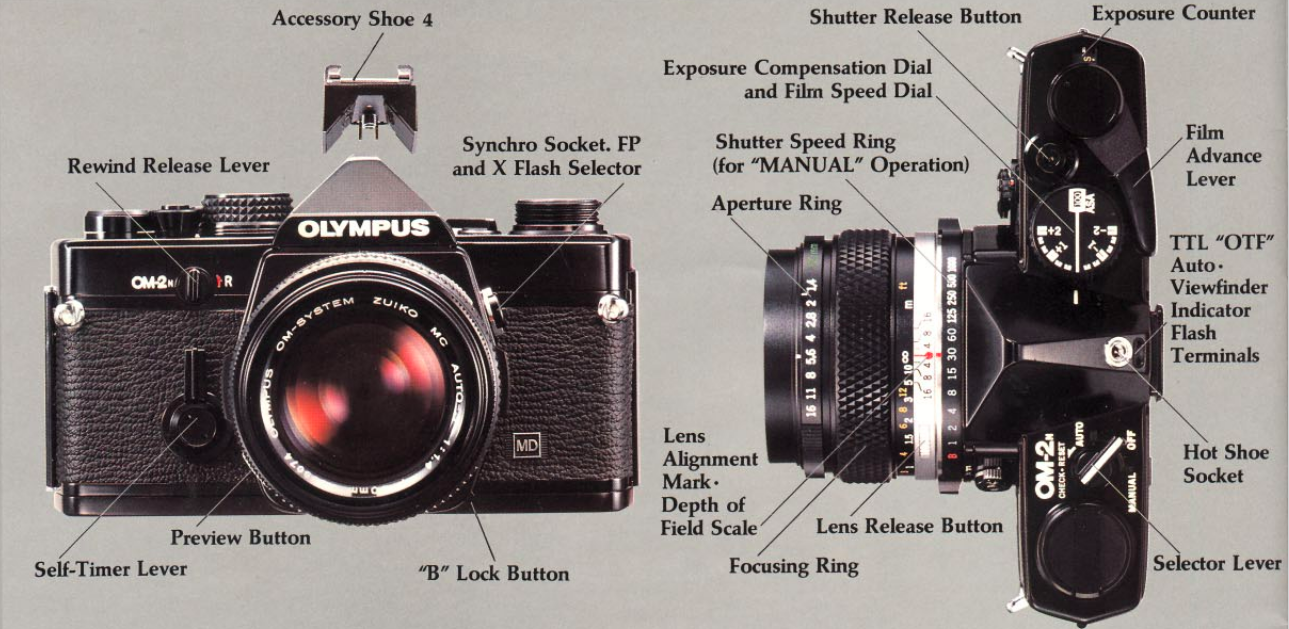
Key Features of the OM-2
- Mechanical + Electronic Hybrid:
Mechanical shutter speeds at 1/60s and Bulb
electronic shutter speeds from 60 seconds to 1/1000s. - Aperture Priority Auto Mode:
Set the aperture, and the OM-2 automatically selects the shutter speed, sometimes invisibly adjusting mid-exposure if needed. - Bright Viewfinder:
Inherited from the OM-1 – 97% frame coverage, clean and simple. - Exposure Compensation Dial:
+/- 2 stops for creative control or challenging lighting. - Modular Flash Hot Shoes:
Detachable, upgradeable hot shoes (2, 3, and 4) supporting flash-ready lights and TTL flash control in later models. - Motor Drive Compatibility (later models):
OM-2 MD and OM-2N models could accept motor drives without modification. - Battery Dependence:
Requires batteries (originally 1.35V mercury, now replaceable with silver oxide or zinc-air).
Without power, defaults to 1/60s and Bulb.
The Evolution: OM-2 vs OM-2N
The OM-2N, launched in 1979, was not a redesign, it was a careful refinement.
| Feature | OM-2 | OM-2N |
|---|---|---|
| Metering System | Off-the-Film (OTF) ADM | Improved OTF with better low-light stability |
| Flash System | Standard X-sync flash | TTL flash metering with T-series flashes |
| Viewfinder Info | Basic aperture readout | Flash-ready LED + aperture scale |
| Motor Drive Ready | Only on OM-2 MD | Standard on OM-2N |
| Hot Shoe | Hot Shoe 2 or 3 (modular) | Hot Shoe 4 (with TTL flash support) |
Real-World Differences:
- The OM-2N meters more accurately in low light and TTL flash is easier to use.
- Flash photography is much faster and more predictable with an OM-2N and Olympus T-series flashes.
But at their core, both cameras deliver the same mechanical precision and near-magical exposure reliability that made the OM system legendary.
How to Estimate the Age of Your OM-2 or OM-2N
| Serial Number Range | Model | Approximate Production Years |
|---|---|---|
| 100000 -299999 | Early OM-2 | 1975-1977 |
| 300000 – 499999 | Late OM-2 / OM-2 MD | 1977-1979 |
| 500000+ | OM-2N | 1979-1987 |
Where to find it:
- Serial number is engraved on the top plate near the rewind lever.
Olympus OM-2 Family: Full Specifications
| Specification | Detail |
|---|---|
| Years Released | 1975 (OM-2), 1979 (OM-2N) |
| Shutter Speeds | 1s – 1/1000s (Auto: 60 – 1/1000s), Bulb |
| Flash Sync | 1/60s |
| Metering | Off-the-Film (OTF) Auto Dynamic Metering |
| Exposure Modes | Manual, Aperture Priority Auto |
| Viewfinder Coverage | ~97% |
| Battery | Two 1.5V SR44 or one 3V CR1/3N |
| Motor Drive Compatibility | From OM-2 MD and OM-2N onward |
| TTL Flash | Only OM-2N with T-series flashes |
| Build Material | Magnesium alloy core |
Brochures and Manuals for Download
- Olympus OM-2 Brochure, 1980 (PDF)
- Olympus OM-2 Instructions at a Glance (PDF)
- Olympus OM-2N User Manual (PDF)
- Inside Your Camera: OM2N (PDF)
- Modern Photography OM-2 Article (PDF)
Final Word
The OM-2 Family represents a turning point in camera history,
the moment when electronic intelligence met mechanical purity.
No clutter. No gimmicks. No compromises.
Even today, in an age of touchscreens and endless menus, an OM-2 or OM-2N still feels like the camera Olympus intended you to use: quiet, fast, precise, and utterly connected to the act of photography itself.
Load a roll. Trust your instincts.
The OM-2 Family was and is, built for photographers who want to see differently.