
By 1983, Olympus had built a reputation for lightweight, mechanical precision.
But the Olympus OM-4 raised the game again,
not by getting bigger, or more automatic, but by giving photographers total exposure control like never before.
The OM-4 wasn’t designed to shoot for you.
It was built to show you everything,
and let you decide exactly what to do.
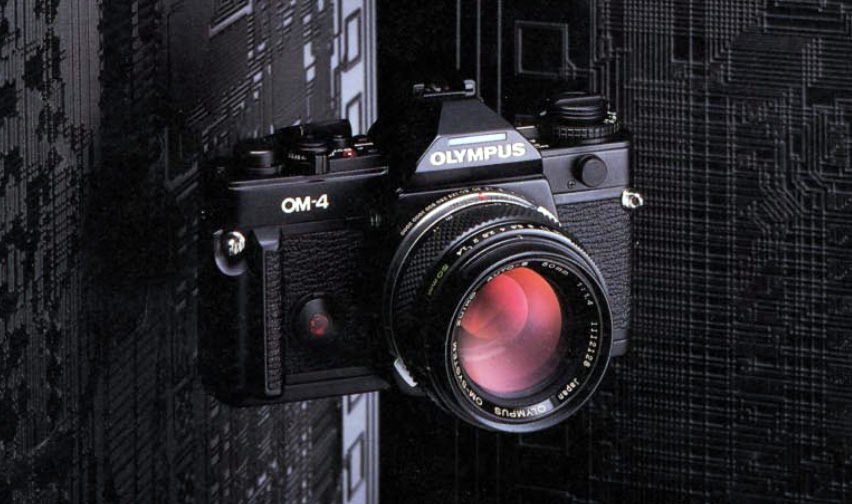
Even today, serious photographers recognise the OM-4 as one of the most intelligent 35mm SLRs ever built.
The Big Breakthrough: Multi-Spot Metering
The OM-4’s headline feature was its Multi-Spot Metering System,
the first of its kind in a production camera.
Here’s how it worked:
- You could take up to 8 spot readings from different parts of the scene.
- The OM-4 would automatically average those readings.
- Or you could bias exposure towards highlights or shadows with a dedicated button.
Result?
Perfect exposure even in extreme lighting, without guessing.
This made the OM-4 a favourite for landscape, architectural, and fine art photographers who demanded complete control.
Key Features of the OM-4
- Multi-Spot Metering:
Store and average up to 8 separate spot readings across the scene. - Highlight/Shadow Bias Buttons:
Quickly adjust exposure to prioritise highlights or shadows, no mental gymnastics needed. - Quartz-Controlled Shutter:
Electronic shutter with precise speeds from 1 second to 1/2000th, plus Bulb.
1/60s mechanical backup if batteries fail. - Massive, Bright Viewfinder:
97% coverage, clean layout with LED shutter speed readouts. - TTL Flash Metering:
Through-the-lens flash control with Olympus T-series flashes. - Integrated Motor Drive Compatibility:
Accepts Motor Drive 2 without modification. - Robust Build:
Magnesium alloy chassis, extremely solid for its size. - Battery Powered:
Requires two SR44 (or equivalent) batteries to function fully.
Without power, defaults to 1/60s and Bulb.
How the OM-4 Evolved from the OM-2N
| Feature | OM-2N | OM-4 |
|---|---|---|
| Shutter | Electronic with mechanical backup | Quartz-controlled electronic |
| Metering | OTF centre-weighted | Multi-Spot + Centre-weighted |
| Viewfinder Display | Basic | Advanced LED readout |
| Flash Metering | TTL (basic) | TTL with auto-check |
| Motor Drive | Optional | Optional (Motor Drive 2 standard) |
In short:
the OM-4 kept the OM DNA alive,
but gave it far more sophisticated metering tools and faster operation.
How to Estimate the Age of Your OM-4
| Serial Number Range | Approximate Production Years |
|---|---|
| 100000-500000 | OM-4 |
Later production shifted to the OM-4Ti (Titanium version) in 1987.
Serial Location:
- Top plate near the rewind crank.
Olympus OM-4: Full Specifications
| Specification | Detail |
|---|---|
| Year Released | 1983 |
| Shutter Speeds | 1s-1/2000s, Bulb |
| Flash Sync | 1/60s |
| Metering Modes | Centre-weighted, Spot, Multi-Spot (up to 8 readings), Highlight/Shadow Bias |
| Exposure Modes | Manual only |
| Viewfinder Coverage | ~97% |
| Motor Drive Compatibility | Yes (Motor Drive 2) |
| Batteries | Two 1.5V SR44 or one 3V CR1/3N |
| Mechanical Backup | 1/60s and Bulb |
| Body Material | Magnesium alloy frame |
Brochures and Manuals for Download
- Olympus OM-4 Brochure (PDF)
- Olympus OM-4 User Manual (PDF)
- Olympus OM-4 for Your Creative Photography (PDF)
Final Word
The OM-4 wasn’t built to make decisions for you.
It was built to make you better.
It gave photographers unprecedented exposure control,
without ever losing the mechanical simplicity that made Olympus famous.
In many ways, the OM-4 was the ultimate expression of Maitani’s philosophy:
Trust the photographer. Give them the tools. Then get out of the way.
And it still stands today as one of the finest tools a serious photographer can hold.