
By 1979, the OM-1 and OM-2 had made Olympus a serious contender among professional photographers.
But Olympus saw another opportunity:
bring the OM experience to a wider audience,
without sacrificing the core quality that made the system famous.
The result was the Olympus OM-10:
an affordable, lightweight SLR designed to deliver brilliant photography for beginners and enthusiasts alike.
Simple? Yes.
But make no mistake, the OM-10 still carried the bloodline of a true OM camera.
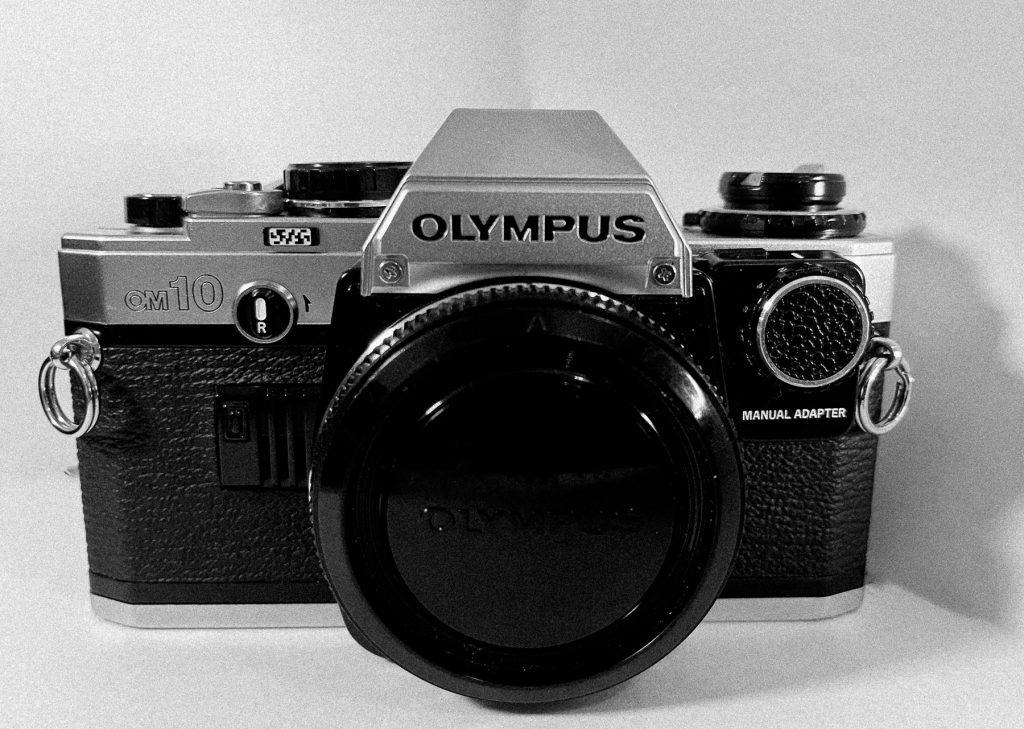
Designed for Simplicity: Aperture Priority First
At launch, the OM-10 operated purely in Aperture Priority Auto Mode.
You selected the aperture, the camera picked the shutter speed automatically.
This made the OM-10 one of the easiest SLRs of its era to pick up and use, especially for newcomers stepping up from point-and-shoots.
Want full manual control?
You could add it later by plugging in the optional Manual Adapter.
Olympus’s logic was smart:
- Keep the base camera streamlined and affordable.
- Offer advanced users a simple upgrade path without intimidating beginners.
Key Features of the OM-10
- Aperture Priority Auto Mode:
The OM-10 automatically selected the correct shutter speed based on aperture and metered light. - Manual Adapter Compatibility:
A small plug-in unit allowed full manual control over shutter speeds (sold separately). - Bright, Large Viewfinder:
~93% coverage, with clear LED indicators showing shutter speed recommendations. - Electronic Shutter:
Quartz-timed from 2 seconds to 1/1000s.
1/45s mechanical backup speed available if batteries fail. - Compact OM Body Style:
Shares much of the OM-1 and OM-2’s physical design DNA, light, small, beautifully balanced. - TTL Flash Metering:
Full through-the-lens flash metering when paired with Olympus T-series flashes. - Motor Drive Compatible:
Accepts Motor Drive 1 or Winder 2 for automatic film advance. - Battery Powered:
Requires two SR44 or equivalent 1.5V batteries for metering and shutter operation.
Olympus OM-10 Manual Adapter: How It Worked
The OM-10’s Manual Adapter was a clever (and cheap) solution:
- Plug it into the dedicated port on the front of the camera.
- Rotate the dial to manually select shutter speeds (from 1s to 1/1000s).
Without the adapter, the OM-10 remained locked in aperture-priority auto mode.
Today, finding a Manual Adapter alongside a working OM-10 is a major bonus.
How the OM-10 Compared to the OM-2N
| Feature | OM-2N | OM-10 |
|---|---|---|
| Metering System | OTF (Advanced) | Centre-weighted |
| Exposure Modes | Aperture Priority + Manual | Aperture Priority (Manual with adapter) |
| Viewfinder Info | Aperture readout + meter | Shutter speed LEDs |
| Build Material | Pro-grade | Consumer-grade |
| Motor Drive Options | Motor Drive 1/2 | Motor Drive 1 / Winder 2 |
The OM-10 wasn’t intended to compete directly with the OM-2N.
It was a gateway, a way to experience Olympus quality without a professional price tag.
How to Estimate the Age of Your OM-10
| Serial Number Range | Approximate Production Years |
|---|---|
| 100000-800000 | OM-10 |
Later OM-10 models were branded Quartz Date editions, offering a date imprinting feature.
Serial Location:
- Engraved on the top plate near the rewind crank.
Olympus OM-10: Full Specifications
| Specification | Detail |
|---|---|
| Year Released | 1979 |
| Shutter Speeds | 2s-1/1000s (Quartz-Timed), 1/45s mechanical backup |
| Flash Sync | 1/45s |
| Metering Mode | Centre-weighted average |
| Exposure Modes | Aperture Priority Auto (Manual with adapter) |
| Viewfinder Coverage | ~93% |
| Motor Drive Compatibility | Winder 2, Motor Drive 1 |
| Batteries | Two 1.5V SR44 or one 3V CR1/3N |
| TTL Flash Support | Yes (with T-series flashes) |
| Build Material | Composite body with magnesium elements |
Manual for Download
Final Word
The OM-10 opened the door for a generation of photographers.
It proved that you didn’t need to mortgage your future to get serious about photography.
Fast, light, reliable and part of one of the greatest 35mm systems ever made.
And if you wanted to grow?
The OM-10 could grow with you.
Even today, it remains one of the best-value entry points into real photography,
an understated legend that earned its place in the Olympus family.