

By 1983, electronic cameras were flooding the market.
Auto-exposure, auto-focus, auto-everything.
But Olympus had a different idea:
What if you built a modern SLR with every technical advancement possible —
without giving up full mechanical control?
The result was the Olympus OM-3:
A precision mechanical SLR armed with the most advanced metering system Olympus ever made.
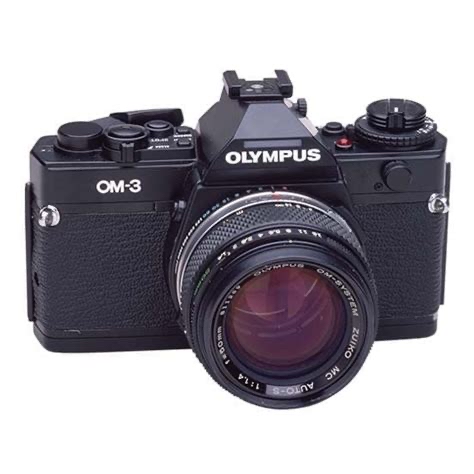
A camera built for photographers who still wanted to think for themselves.
Mechanical Purity, Electronic Precision
At its heart, the OM-3 remains true to the original OM-1 philosophy:
- Fully mechanical shutter speeds from 1 second to 1/2000th, plus Bulb.
- Mechanical operation even without batteries.
But Olympus added something new:
- Spot Metering.
- Highlight and Shadow Bias Controls.
- Centre-Weighted Average Metering.
The OM-3 gave you sophisticated exposure information —
but left the final decision in your hands, not the camera’s.
It was the ultimate tool for photographers who knew exactly what they wanted —
and exactly how to get it.
Key Features of the OM-3
- Fully Mechanical Shutter:
Operates completely independently of batteries.
Battery only powers the light meter. - Advanced Metering System:
- Centre-Weighted Average Metering for general use.
- 2% Spot Metering for precision highlights or shadows.
- Highlight and Shadow Compensation Buttons to bias exposures intelligently — without guessing.
- Motor Drive Compatibility:
Works with Olympus Motor Drive 2 for high-speed sequences. - Massive, Clear Viewfinder:
97% coverage, aperture and exposure display, viewfinder LEDs for metering guidance. - Battery Requirements:
Only for metering (two SR44 or equivalent batteries).
All shutter speeds available mechanically without power. - Quartz-Timed Accuracy:
Even though fully mechanical, speeds are regulated for ultimate consistency.
OM-3 vs OM-1: What’s Different?
| Feature | OM-1 | OM-3 |
|---|---|---|
| Shutter Speed Range | 1s – 1/1000s | 1s – 1/2000s |
| Metering | Centre-weighted only | Centre-weighted + Spot + Highlight/Shadow Bias |
| Flash Support | Basic X-sync | TTL Flash Metering (with T-series flashes) |
| Motor Drive | Optional (MD models) | Built-in Motor Drive compatibility |
| Battery Dependence | Light meter only | Light meter only |
The OM-3 is not a replacement for the OM-1.
It’s the OM-1’s final evolution — the full flowering of Maitani’s original vision, with the wisdom of another decade of innovation.
How to Estimate the Age of Your OM-3
| Serial Number Range | Approximate Production Years |
|---|---|
| 100000 – 250000 | OM-3 |
Production was limited compared to earlier OM bodies.
The OM-3 was a niche, premium tool — not a mass-market bestseller —
making surviving examples highly prized today.
Serial Location:
- Top plate near the rewind lever.
Olympus OM-3: Full Specifications
| Specification | Detail |
|---|---|
| Year Released | 1983 |
| Shutter Speeds | 1s – 1/2000s, Bulb |
| Flash Sync | 1/60s |
| Metering | Centre-weighted, Spot, Highlight/Shadow Bias |
| Exposure Modes | Manual only |
| Viewfinder Coverage | ~97% |
| Motor Drive Compatible | Yes (Motor Drive 2) |
| Batteries | Two 1.5V SR44 or one 3V CR1/3N (for meter only) |
| Build Material | Magnesium alloy core |
Brochures and Manuals for Download
- Olympus OM-3 Camera Manual (PDF)
- Olympus OM-3 User Manual for Creative Photography (PDF)
- OM-3 Test by Modern Photography (PDF)
- OM-3 Test by Popular Photographer (PDF)
Final Word
The Olympus OM-3 is a machine built for a rarer kind of photographer —
someone who values freedom over automation, understanding over shortcuts.
It rewards careful thinking.
It rewards seeing the light — and knowing exactly what to do with it.
In a world of cameras trying to do everything for you,
the OM-3 still whispers the same quiet message:
You are in control.
And that is the point.