
By 1983, electronic cameras were flooding the market.
Auto-exposure, auto-focus, auto-everything.
But Olympus had a different idea:
What if you built a modern SLR with every technical advancement possible,
without giving up full mechanical control?
The result was the Olympus OM-3:
A precision mechanical SLR armed with the most advanced metering system Olympus ever made.
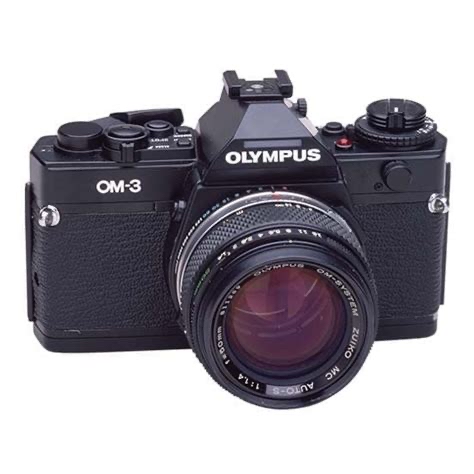
A camera built for photographers who still wanted to think for themselves.
Mechanical Purity, Electronic Precision
At its heart, the OM-3 remains true to the original OM-1 philosophy:
- Fully mechanical shutter speeds from 1 second to 1/2000th, plus Bulb.
- Mechanical operation even without batteries.
But Olympus added something new:
- Spot Metering.
- Highlight and Shadow Bias Controls.
- Centre-Weighted Average Metering.
The OM-3 gave you sophisticated exposure information,
but left the final decision in your hands, not the camera’s.
It was the ultimate tool for photographers who knew exactly what they wanted,
and exactly how to get it.
Key Features of the OM-3
- Fully Mechanical Shutter:
Operates completely independently of batteries.
Battery only powers the light meter. - Advanced Metering System:
- Centre-Weighted Average Metering for general use.
- 2% Spot Metering for precision highlights or shadows.
- Highlight and Shadow Compensation Buttons to bias exposures intelligently, without guessing.
- Motor Drive Compatibility:
Works with Olympus Motor Drive 2 for high-speed sequences. - Massive, Clear Viewfinder:
97% coverage, aperture and exposure display, viewfinder LEDs for metering guidance. - Battery Requirements:
Only for metering (two SR44 or equivalent batteries).
All shutter speeds available mechanically without power. - Quartz-Timed Accuracy:
Even though fully mechanical, speeds are regulated for ultimate consistency.
OM-3 vs OM-1: What’s Different?
| Feature | OM-1 | OM-3 |
|---|---|---|
| Shutter Speed Range | 1s-1/1000s | 1s-1/2000s |
| Metering | Centre-weighted only | Centre-weighted + Spot + Highlight/Shadow Bias |
| Flash Support | Basic X-sync | TTL Flash Metering (with T-series flashes) |
| Motor Drive | Optional (MD models) | Built-in Motor Drive compatibility |
| Battery Dependence | Light meter only | Light meter only |
The OM-3 is not a replacement for the OM-1.
It’s the OM-1’s final evolution, the full flowering of Maitani’s original vision, with the wisdom of another decade of innovation.
How to Estimate the Age of Your OM-3
| Serial Number Range | Approximate Production Years |
|---|---|
| 100000-250000 | OM-3 |
Production was limited compared to earlier OM bodies.
The OM-3 was a niche, premium tool, not a mass-market bestseller,
making surviving examples highly prized today.
Serial Location:
- Top plate near the rewind lever.
Olympus OM-3: Full Specifications
| Specification | Detail |
|---|---|
| Year Released | 1983 |
| Shutter Speeds | 1s-1/2000s, Bulb |
| Flash Sync | 1/60s |
| Metering | Centre-weighted, Spot, Highlight/Shadow Bias |
| Exposure Modes | Manual only |
| Viewfinder Coverage | ~97% |
| Motor Drive Compatible | Yes (Motor Drive 2) |
| Batteries | Two 1.5V SR44 or one 3V CR1/3N (for meter only) |
| Build Material | Magnesium alloy core |
Brochures and Manuals for Download
- Olympus OM-3 Camera Manual (PDF)
- Olympus OM-3 User Manual for Creative Photography (PDF)
- OM-3 Test by Modern Photography (PDF)
- OM-3 Test by Popular Photographer (PDF)
Final Word
The Olympus OM-3 is a machine built for a rarer kind of photographer,
someone who values freedom over automation, understanding over shortcuts.
It rewards careful thinking.
It rewards seeing the light and knowing exactly what to do with it.
In a world of cameras trying to do everything for you,
the OM-3 still whispers the same quiet message:
You are in control.
And that is the point.