
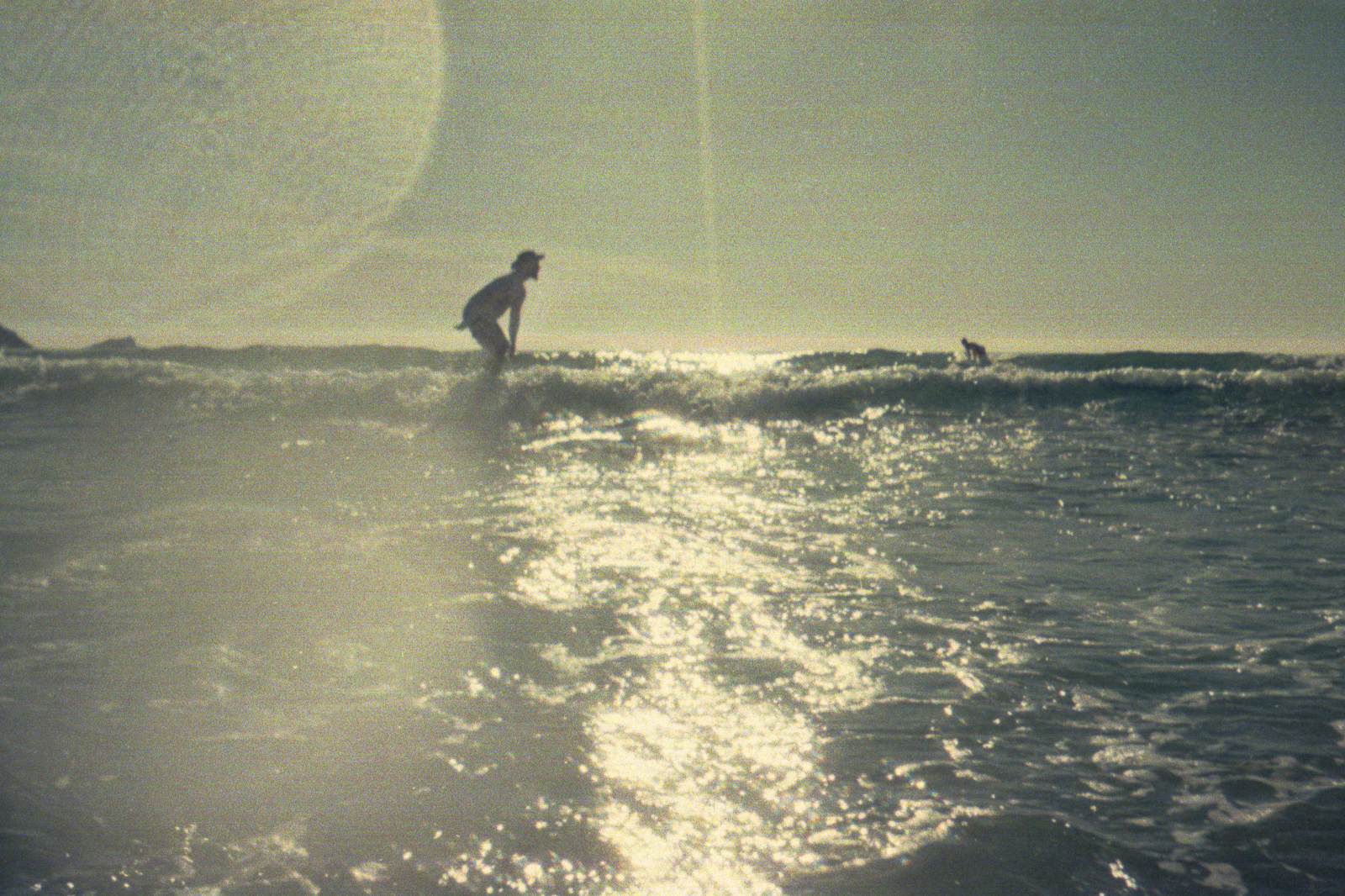
Some photographic ideas refuse to go away.
For years I’d wondered whether I could successfully use an Olympus OM underwater. I already owned an EWA Marine housing and had previously used it with my Nikon F80, but I kept coming back to the idea of trying it with an Olympus.
A few days in Newquay gave me the perfect excuse to finally stop thinking about it and give it a go.
To keep the experiment honest, I purchased two Kodak waterproof disposable cameras. They weren’t there as backups. They were there because I wanted to know whether the extra effort of using an SLR inside a waterproof housing actually resulted in better photographs – or whether a £20 disposable could do the job just as well.
This isn’t a review of the EWA Marine housing.
It isn’t a guide to underwater photography either.
It’s simply an honest account of what happened when I finally stopped wondering and took an Olympus into the Atlantic.
Although this experiment uses an Olympus OM-10, many of the lessons apply equally to other 35mm SLRs used in flexible underwater housings.
Preparing the Camera
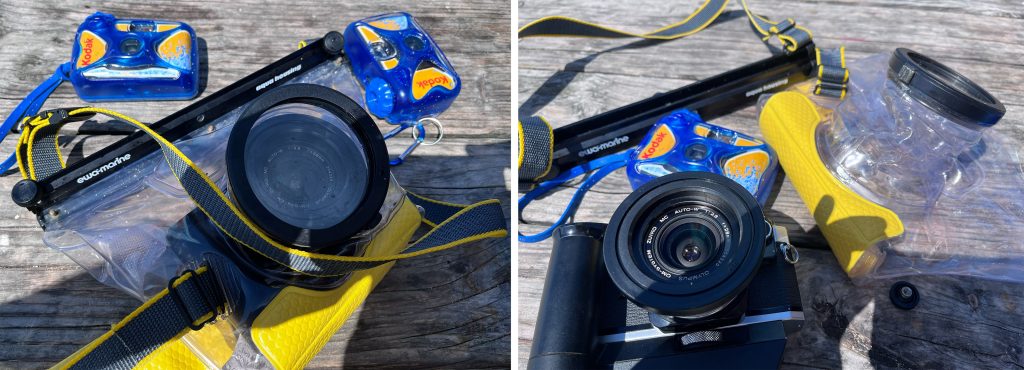
One of the aims of this experiment was to use equipment I already owned.
It would have been easy to buy a Nikonos and declare it the perfect solution, but that wasn’t really the question I wanted to answer. The Nikonos has a deserved reputation as one of the greatest underwater cameras ever made, but it’s also another camera system to buy, maintain and trust. Waterproof cameras rely on seals and O-rings being in good condition and, unless you know their history, there’s always a small question mark hanging over them.
I already owned an EWA Marine housing and several Olympus OM bodies. Before investing in another camera, I wanted to know whether the equipment already sitting in my camera cupboard could do the job. If it worked, I’d save myself buying another camera. If it didn’t, then at least I’d know why.
The OM-10 quickly became the obvious choice.
I owned several of them, so if the worst happened it wasn’t irreplaceable. It also accepted the Olympus Motor Winder 2 and offered aperture-priority auto exposure, two things I thought would make life considerably easier in the water.
The lens was a Zuiko 28mm f/2.8.
A wide-angle lens made sense underwater. I could get physically closer to my subjects and, by pre-focusing the lens before sealing the camera inside the housing, rely on depth of field rather than trying to focus through layers of flexible plastic.
The Motor Winder 2 turned out to be an essential part of the setup.
Using the advance lever inside an EWA Marine housing isn’t awkward.
It’s virtually impossible.
The motor winder solved that problem completely. One press of the shutter and the camera advanced itself ready for the next frame. As an added bonus, I’ve always loved the sound it makes. There’s something incredibly satisfying about hearing it wind on after every photograph.
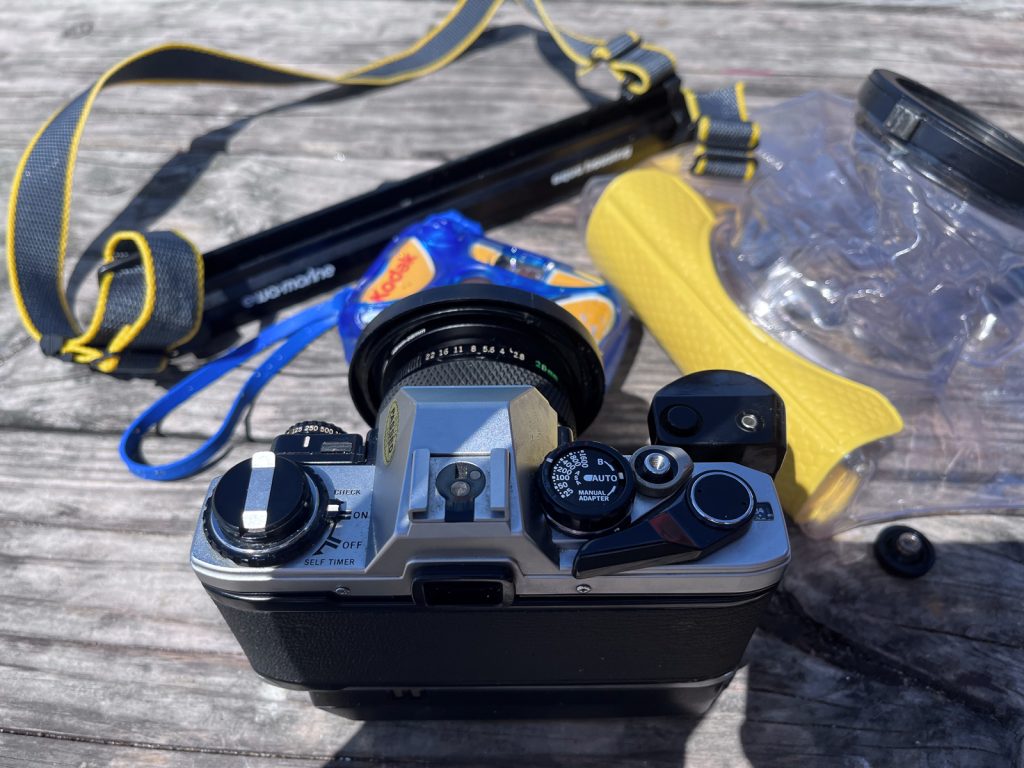
For the surf session I loaded Kodak Gold 200. Bright sunshine and plenty of contrast made it an easy choice.
For the snorkelling session, I loaded Portra 400. I wanted a little more flexibility underwater and hoped the finer grain and colour would suit the calmer conditions if everything else went to plan.
Before sealing the housing, I also packed a couple of silica gel packets in the hope they would deal with any moisture trapped inside.
As it turned out, they had other plans.
Alongside the Olympus I packed two Kodak waterproof disposable cameras.
Originally, they were simply there for comparison. If the OM-10 justified all the extra effort of using a waterproof housing, great. If the disposables held their own, that would be equally interesting.
One final twist came before the experiment had even started.
My original plan had been to use my black OM-10, but it developed a fault on the first evening in Newquay before it ever reached the water. Fortunately, I’d packed a silver OM-10 as a spare.
It wasn’t supposed to be the camera for this article.
It quietly became the camera that made it possible.
Surfing
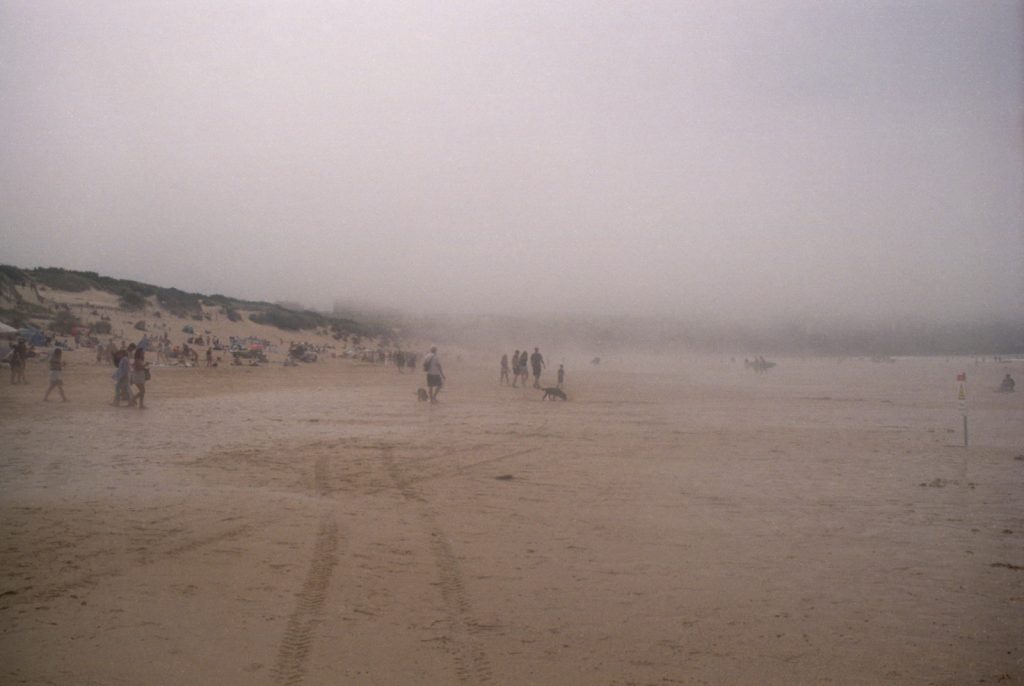
The surf session was the part of the trip I’d been looking forward to most. After all, this was the reason I’d brought the housing in the first place.
I’d already used my Nikon F80 in the EWA Marine housing on a previous visit to Newquay and came away with photographs I was genuinely pleased with. This time, I wanted to find out whether an Olympus OM could produce similar results.
Unfortunately, the experiment went wrong almost immediately.
As soon as I entered the water, the inside of the housing fogged with condensation. I’d packed silica gel hoping it would prevent exactly that, but it made little difference. Apart from the first couple of frames, the remaining thirty-five photographs disappeared behind a layer of mist.
There wasn’t much I could do about it.
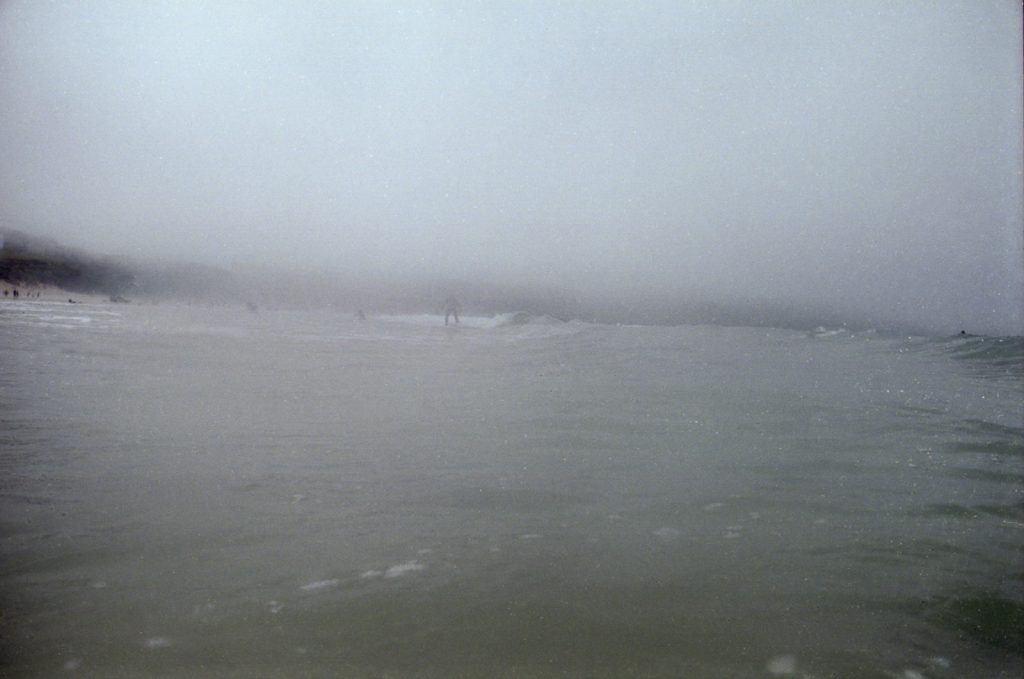
Once the housing is sealed and you’re standing in the Atlantic, opening it simply isn’t an option. I carried on shooting, hoping something might be salvageable, but by the time I came back to shore I already knew how the roll would look.
It was disappointing.
That’s exactly why I wanted to do the experiment.
If I’d left the camera at home, I’d still be wondering whether it would work.
Now I knew.
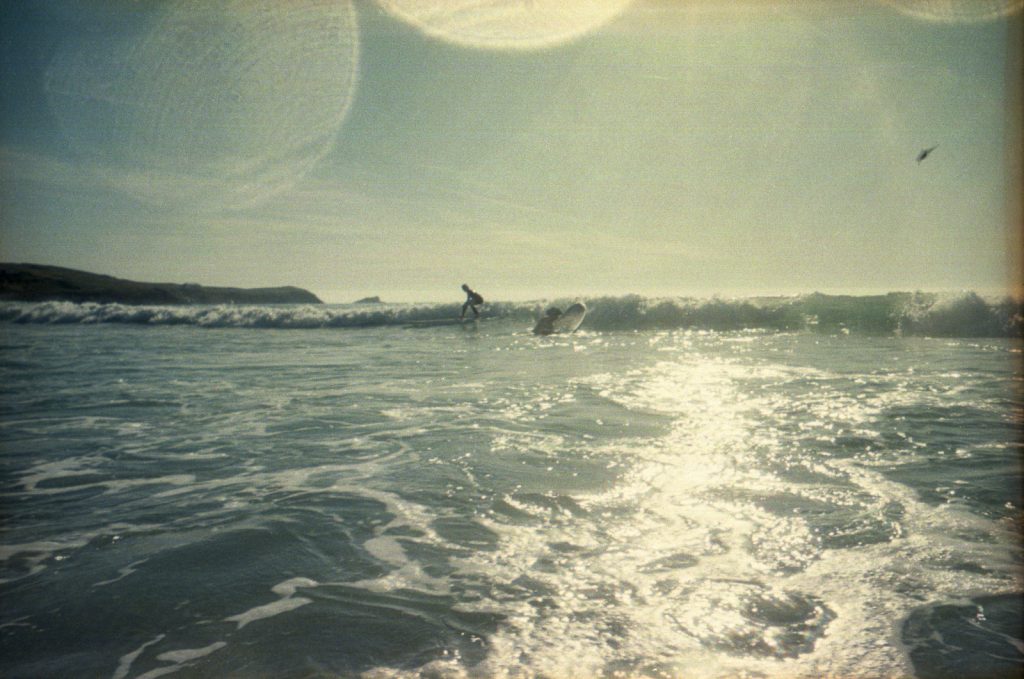
Fortunately, I also had a waterproof disposable camera.
Originally it was there as a benchmark. Instead, it quietly became the star of the surf session.
It’s wonderfully uncomplicated. No housing. No settings. No worrying about expensive equipment. You simply point it in roughly the right direction, press the shutter and get back to enjoying the water.
That simplicity made a huge difference.
Instead of thinking about the camera, I could think about where the surfers were, where the light was coming from and where I needed to be before the next wave arrived.
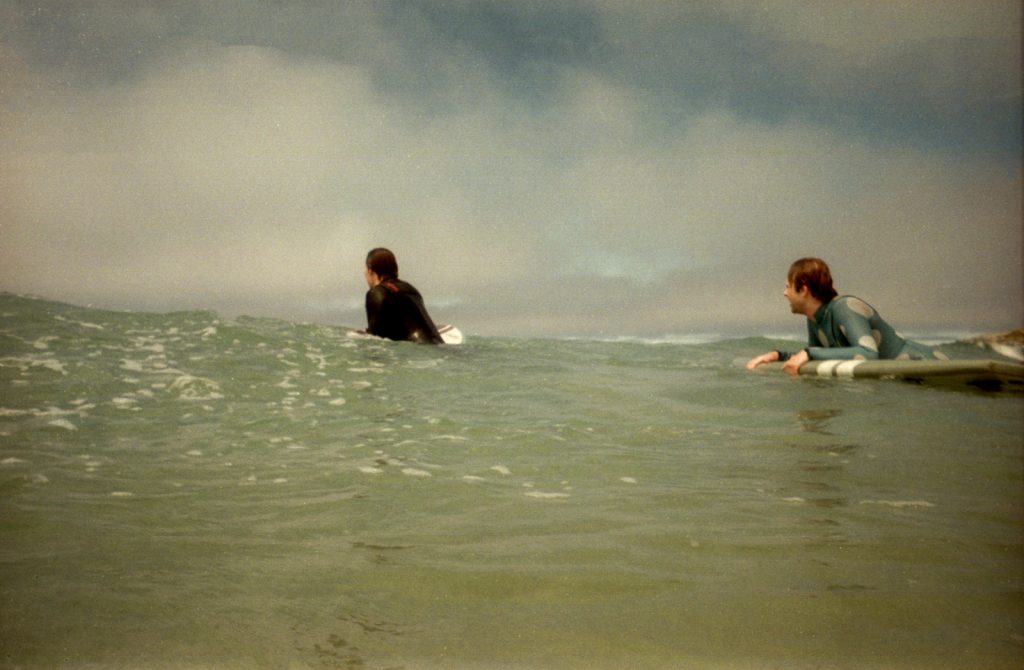
The action photographs were satisfying, but they weren’t the ones I kept coming back to.
What interested me more were the moments between the waves.
Most people imagine surfing as constant action, yet the reality is very different. You spend far longer sitting beyond the break, watching the horizon and chatting while waiting for the next set than you do actually surfing.
Those quieter moments felt like the real story.
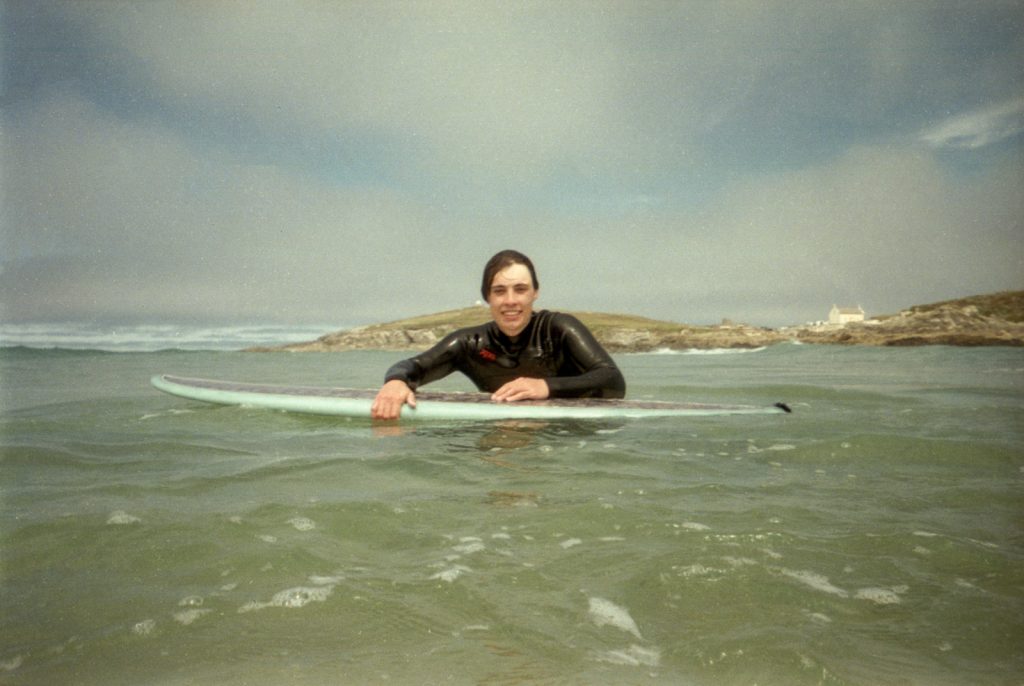
That was certainly true of this portrait.
While we waited for the next set, I paddled over, explained that I was experimenting with underwater film photography and asked if he’d mind me making a portrait. He smiled, was more than happy to help and sat there while I made the frame.
It’s probably my favourite photograph from the surf session.
Not because it’s technically the strongest image, but because it captures something the action shots don’t. For a few minutes, I wasn’t photographing surfers from the beach.
I was simply another person sitting in the water with a camera.
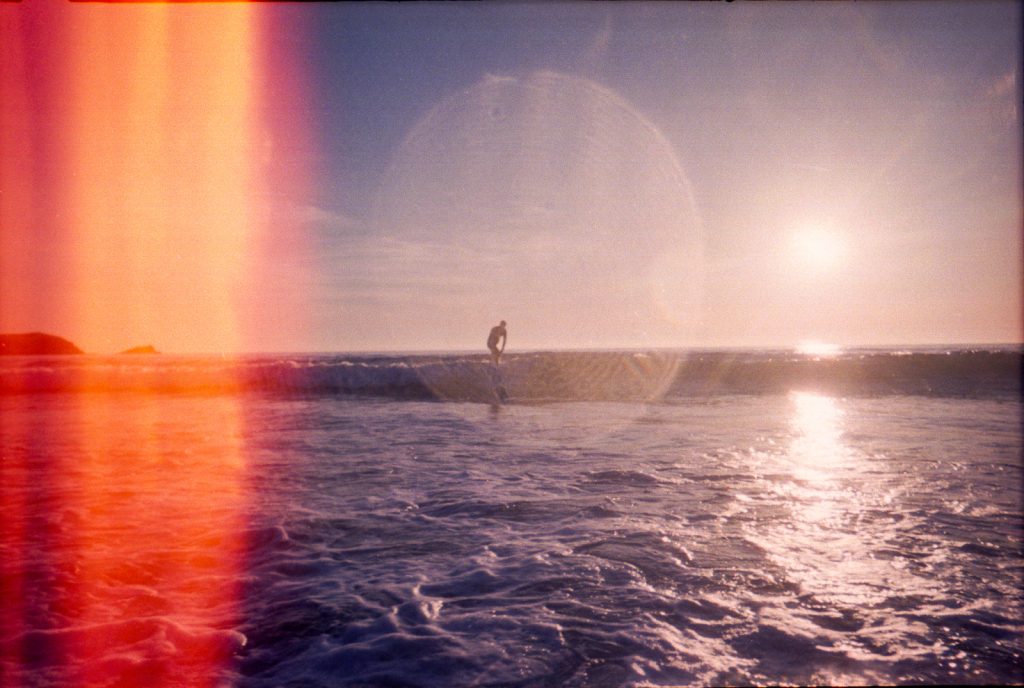
The disposable even produced the occasional surprise.
One frame picked up a light leak. Normally it would have gone straight in the reject pile. This time it stayed.
It somehow suits the photograph.
Perfection was never really the point of this trip.
It was about seeing what happened.
By the end of the morning I’d learnt something I wasn’t expecting.
The OM-10 had never really had a chance.
The waterproof disposable had quietly produced my favourite surfing photographs of the trip.
I hadn’t packed it expecting that.
Snorkelling
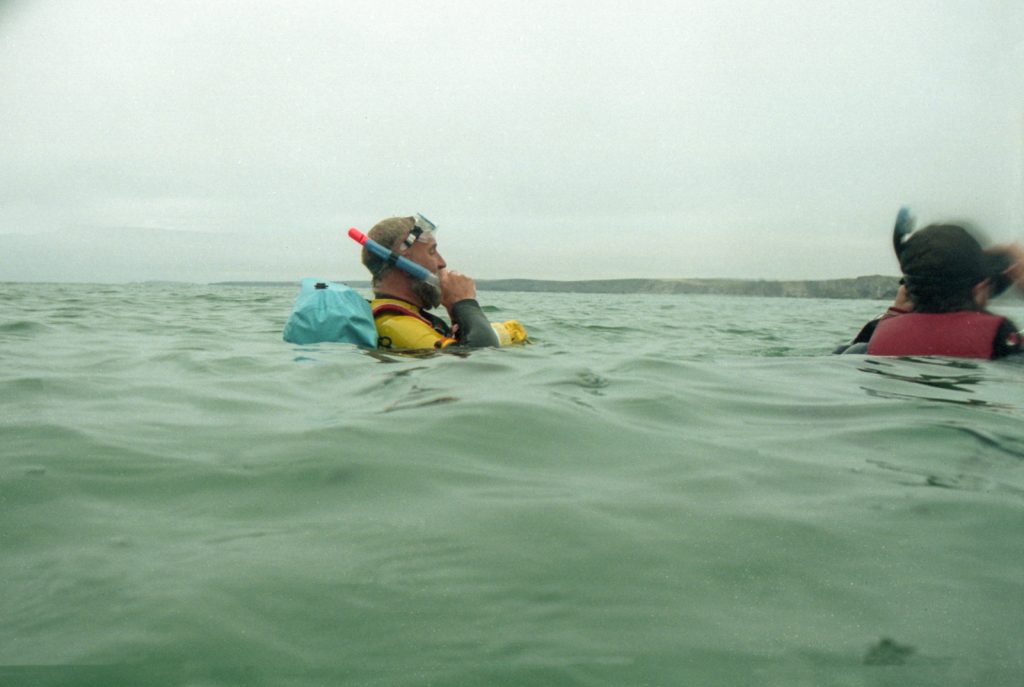
After the surf session, I wasn’t expecting much from the Olympus.
Thankfully, the snorkelling trip couldn’t have been more different.
Instead of fighting breaking waves, I was able to drift slowly over the reef, taking my time and looking for photographs rather than reacting to them. It immediately felt like a much better environment for the OM-10 and, for the first time during the trip, I could use the camera in the way I’d imagined when I first packed it.
Using two cameras underwater also turned out to be much easier than I’d expected.
The EWA Marine housing hung around my neck, with one hand permanently inside the sleeve ready to press the shutter whenever something caught my eye. The second waterproof disposable camera was clipped to the housing strap with a cheap karabiner, so it was always within easy reach. It wasn’t the most elegant setup, but it worked surprisingly well and meant I could swap between the two cameras in seconds without worrying about dropping one into the sea.
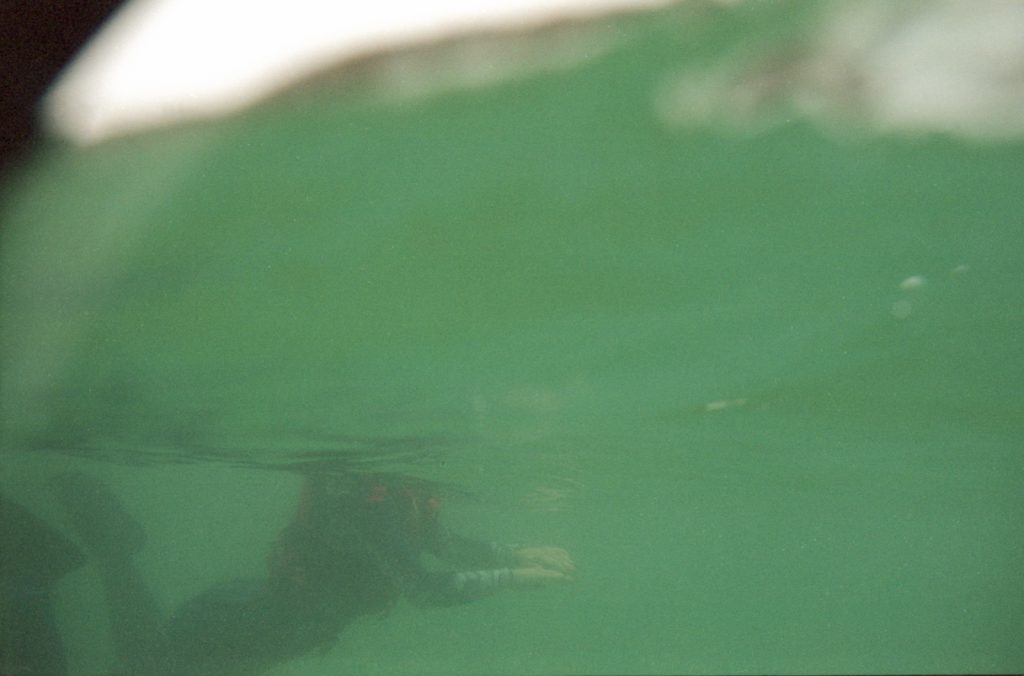
One of my favourite photographs from the morning is of one of the snorkelling instructors waiting on the surface while the rest of the group caught up.
It isn’t the most dramatic image from the trip, but I like it because it captures the atmosphere of the morning perfectly. Calm water, clear visibility and absolutely no rush.
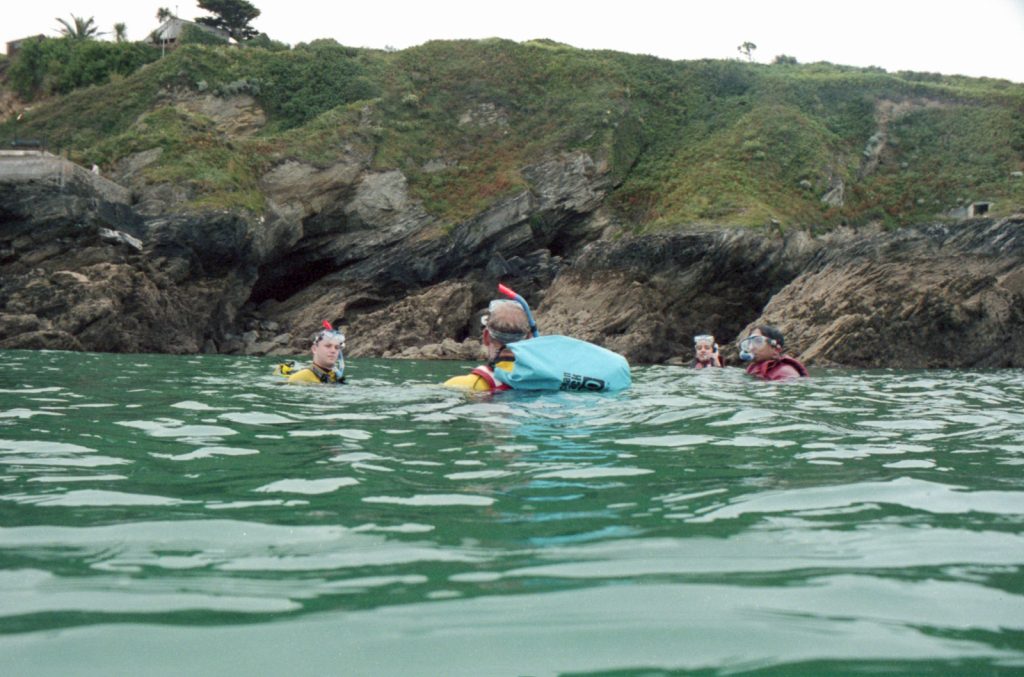
The pace of snorkelling is completely different to surfing.
Instead of constantly watching the waves, you’re free to stop, look around and notice the underwater world beneath you. Small fish appeared between the rocks, patches of seaweed moved with the current and every few metres seemed to reveal something else worth photographing.
It felt less like chasing photographs and more like discovering them.
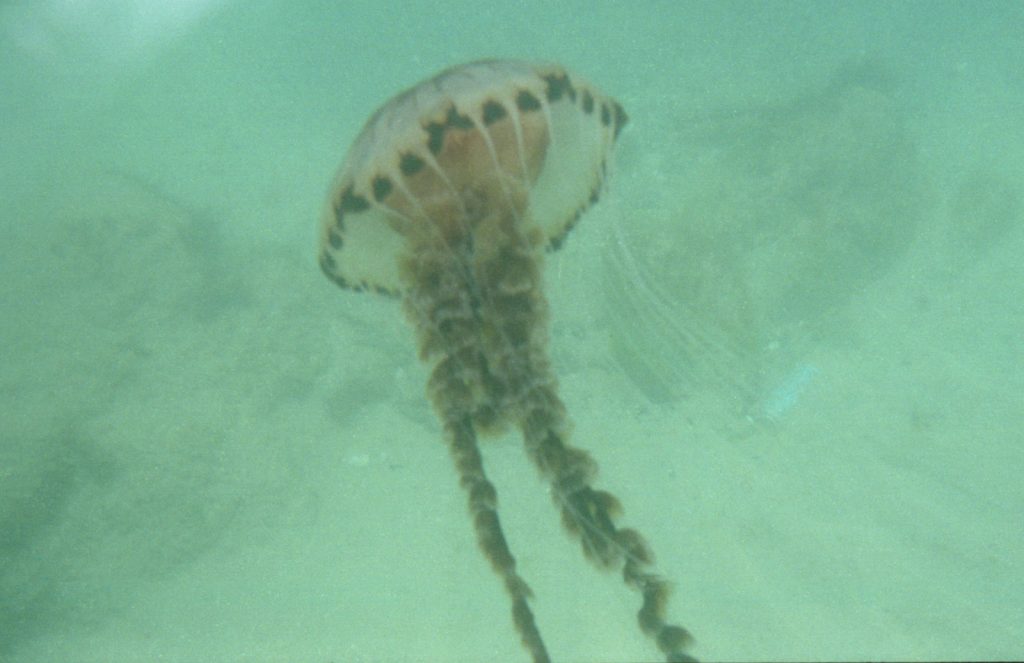
Then came the jellyfish.
This was the photograph I’d been hoping to come home with.
Not because it’s technically perfect, but because it’s exactly the sort of image that had inspired the whole experiment in the first place. A photograph I simply couldn’t have made standing on the beach.
If I’d come home with nothing else from the Olympus, this frame alone would have made carrying it worthwhile.
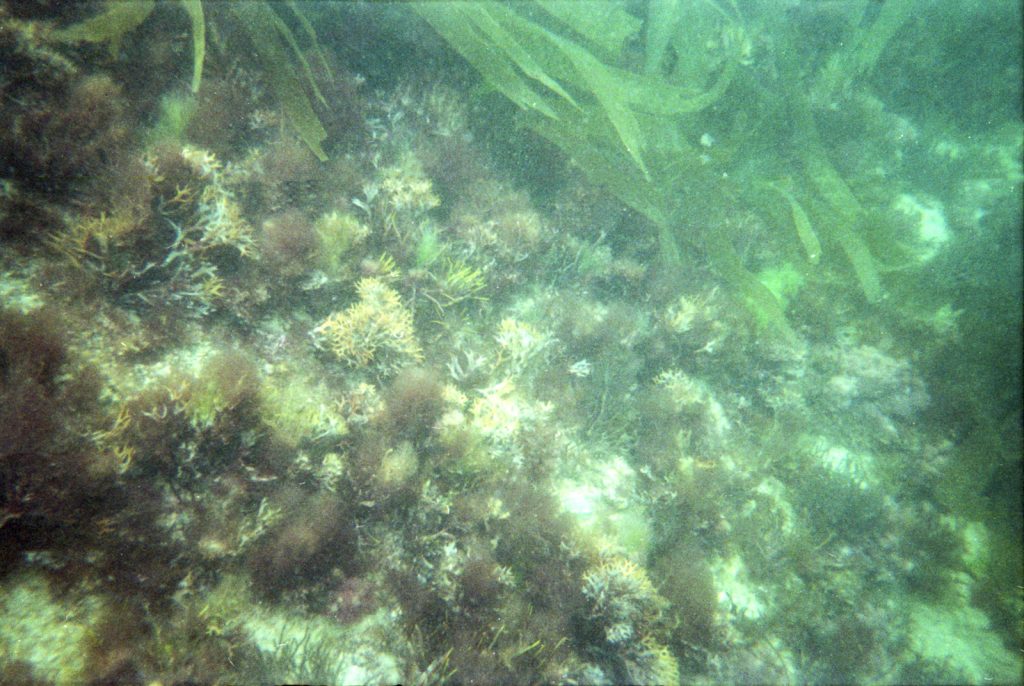
For the snorkelling trip, I also brought along the second waterproof disposable.
Just like the first, it reminded me why these cameras have remained so popular for holidays and days at the beach.
The wider photographs of the reef, seaweed and underwater landscape all came from the disposable. It was quick, uncomplicated and encouraged me to photograph anything that caught my eye without wondering whether it was worth taking.
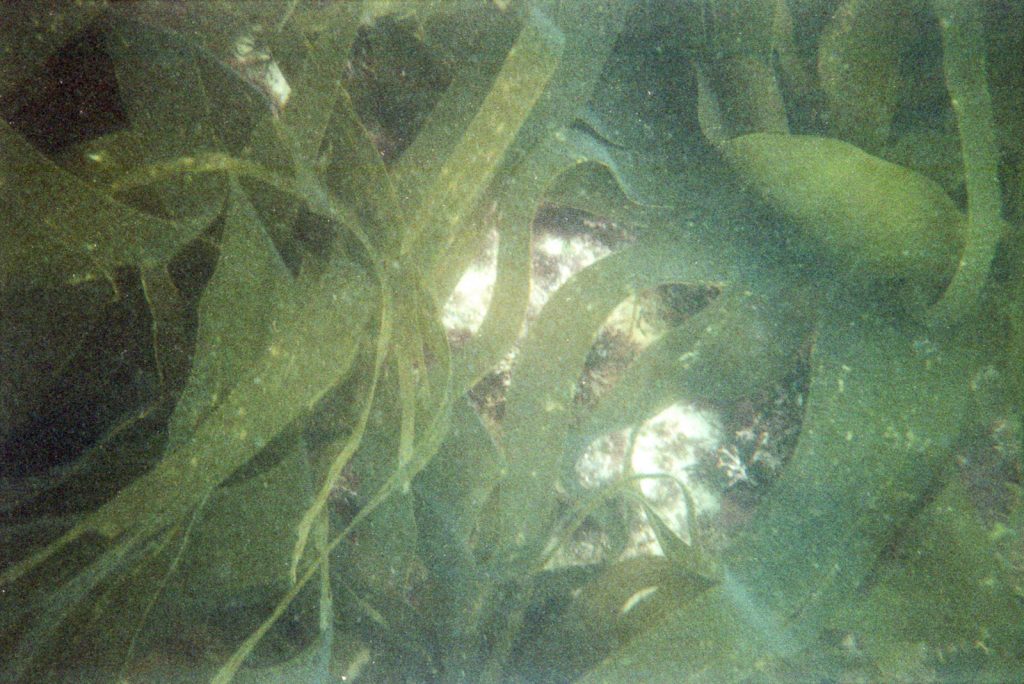
That freedom encouraged experimentation.
Patterns in the kelp, sunlight filtering through the water and the textures of the rocks all became photographs simply because making them felt effortless.
Ironically, the simplest camera I carried often encouraged the most experimental way of photographing.
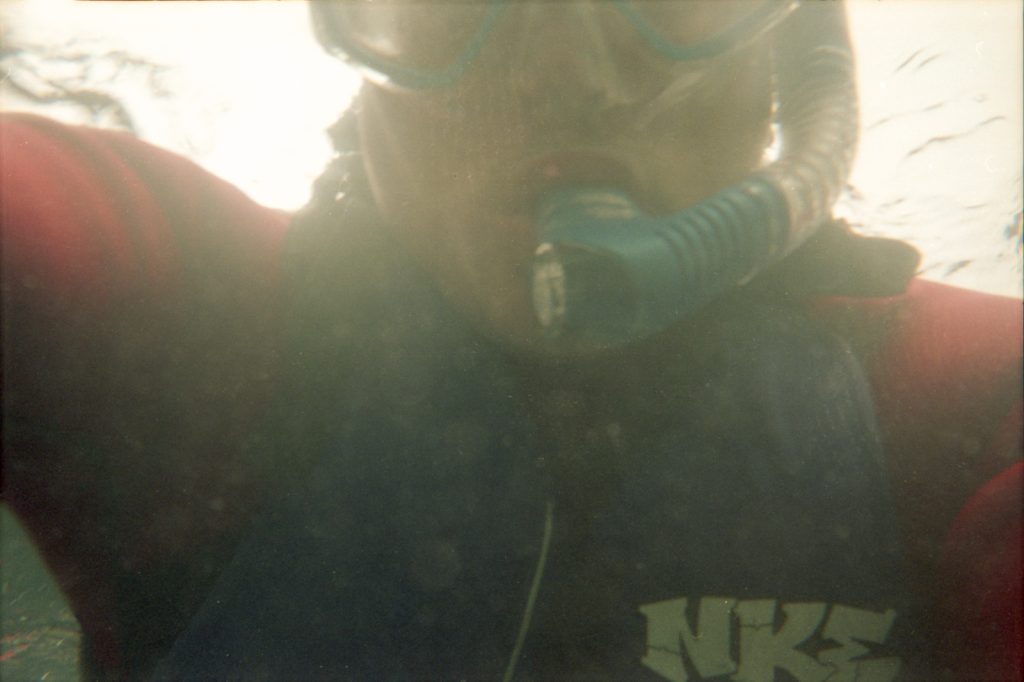
The same was true of the underwater selfie.
Trying to turn the OM-10 around inside the housing would have been awkward and, if I’m honest, a little nerve-racking.
The disposable, on the other hand, made it easy.
It’s hardly the best photograph from the trip, but it remains one of my favourites because it captures something the others don’t.
The simple enjoyment of being in the water.
By the end of the snorkelling trip, I’d stopped thinking about which camera was supposed to win.
The Olympus had produced the photograph I’d hoped for.
The disposable had encouraged me to make photographs I probably wouldn’t have taken otherwise.
That wasn’t the result I’d expected when I arrived in Newquay.
Waiting for the Results
Leaving Newquay didn’t mean the experiment was over.
Before heading home, I dropped all four rolls of film off for development at a local lab. That answered the first question almost immediately. There were photographs on the negatives.
After the surf session, that alone felt like good news.
Of course, negatives only tell you so much.
You can hold them up to the light and convince yourself you’ve got something, but it’s not until they’re scanned that you really know what you’ve made. That part of the experiment had to wait until I got home.
Back in front of the scanner, the story slowly began to reveal itself frame by frame.
The surf roll looked exactly as I’d feared. The first couple of frames survived before condensation gradually swallowed almost everything that followed.
The snorkelling rolls, however, told a completely different story.
The instructor was there.
The jellyfish was there too.
The disposable had quietly recorded the reef, seaweed and underwater landscapes that I’d enjoyed photographing so much.
It was only then, seeing all four rolls together, that the experiment finally made sense.
The Olympus hadn’t failed.
The disposable hadn’t unexpectedly won.
Each camera had simply found the conditions that suited it best.
With the scans complete, I finally had the answer I’d travelled to Cornwall to find.
Conclusion
So, was the experiment worth it?
Absolutely.
The OM-10 gave me my favourite photograph of the trip. The image of the jellyfish alone justified carrying the extra equipment into the sea, and the snorkelling session proved that, in the right conditions, an old Olympus inside an EWA Marine housing is perfectly capable of producing photographs I’d be delighted to come home with.
The surf session, however, taught me something just as valuable.
Condensation isn’t a minor inconvenience; it’s the biggest challenge I encountered during the entire experiment. If I take the OM underwater again – and I will – solving that problem will be my first priority.
The biggest surprise, though, came from the waterproof disposable cameras.
I packed them simply as something to compare against the Olympus. Instead, they became some of the most enjoyable cameras I’ve used in years. They encouraged me to experiment, to stop worrying about equipment and simply react to whatever was happening around me. Some of my favourite surfing photographs, the reef, the underwater landscapes and even the underwater selfie all came from cameras that cost less than a filter for the Olympus.
That wasn’t the result I expected.
Looking back, the experiment answered every question I’d set out to answer.
I know what the OM-10 is capable of underwater.
I know where the EWA Marine housing falls short.
And I know I’ll never underestimate a waterproof disposable camera again.
Will I take the Olympus underwater again?
Without hesitation.
And next time, there’ll be another waterproof disposable clipped alongside it.