

By 1983, Olympus had built a reputation for lightweight, mechanical precision.
But the Olympus OM-4 raised the game again —
not by getting bigger, or more automatic, but by giving photographers total exposure control like never before.
The OM-4 wasn’t designed to shoot for you.
It was built to show you everything —
and let you decide exactly what to do.
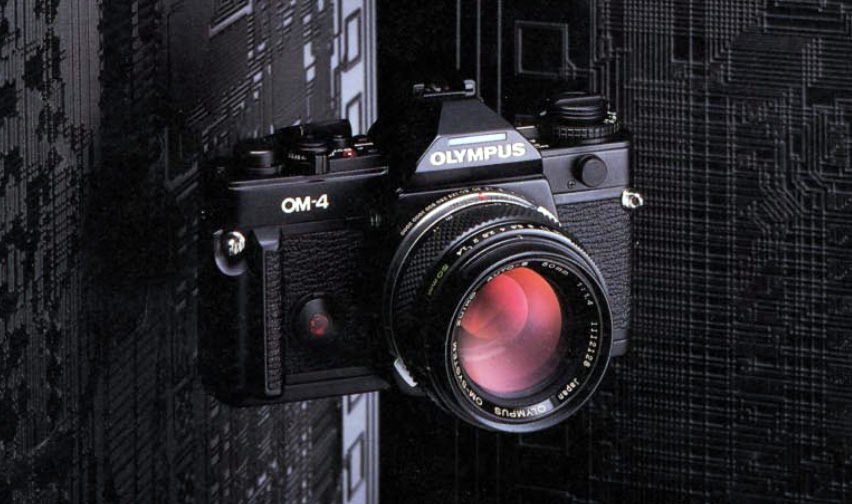
Even today, serious photographers recognise the OM-4 as one of the most intelligent 35mm SLRs ever built.
The Big Breakthrough: Multi-Spot Metering
The OM-4’s headline feature was its Multi-Spot Metering System —
the first of its kind in a production camera.
Here’s how it worked:
- You could take up to 8 spot readings from different parts of the scene.
- The OM-4 would automatically average those readings.
- Or you could bias exposure towards highlights or shadows with a dedicated button.
Result?
Perfect exposure even in extreme lighting — without guessing.
This made the OM-4 a favourite for landscape, architectural, and fine art photographers who demanded complete control.
Key Features of the OM-4
- Multi-Spot Metering:
Store and average up to 8 separate spot readings across the scene. - Highlight/Shadow Bias Buttons:
Quickly adjust exposure to prioritise highlights or shadows — no mental gymnastics needed. - Quartz-Controlled Shutter:
Electronic shutter with precise speeds from 1 second to 1/2000th, plus Bulb.
1/60s mechanical backup if batteries fail. - Massive, Bright Viewfinder:
97% coverage, clean layout with LED shutter speed readouts. - TTL Flash Metering:
Through-the-lens flash control with Olympus T-series flashes. - Integrated Motor Drive Compatibility:
Accepts Motor Drive 2 without modification. - Robust Build:
Magnesium alloy chassis, extremely solid for its size. - Battery Powered:
Requires two SR44 (or equivalent) batteries to function fully.
Without power, defaults to 1/60s and Bulb.
How the OM-4 Evolved from the OM-2N
| Feature | OM-2N | OM-4 |
|---|---|---|
| Shutter | Electronic with mechanical backup | Quartz-controlled electronic |
| Metering | OTF centre-weighted | Multi-Spot + Centre-weighted |
| Viewfinder Display | Basic | Advanced LED readout |
| Flash Metering | TTL (basic) | TTL with auto-check |
| Motor Drive | Optional | Optional (Motor Drive 2 standard) |
In short:
the OM-4 kept the OM DNA alive —
but gave it far more sophisticated metering tools and faster operation.
How to Estimate the Age of Your OM-4
| Serial Number Range | Approximate Production Years |
|---|---|
| 100000 – 500000 | OM-4 |
Later production shifted to the OM-4Ti (Titanium version) in 1987.
Serial Location:
- Top plate near the rewind crank.
Olympus OM-4: Full Specifications
| Specification | Detail |
|---|---|
| Year Released | 1983 |
| Shutter Speeds | 1s – 1/2000s, Bulb |
| Flash Sync | 1/60s |
| Metering Modes | Centre-weighted, Spot, Multi-Spot (up to 8 readings), Highlight/Shadow Bias |
| Exposure Modes | Manual only |
| Viewfinder Coverage | ~97% |
| Motor Drive Compatibility | Yes (Motor Drive 2) |
| Batteries | Two 1.5V SR44 or one 3V CR1/3N |
| Mechanical Backup | 1/60s and Bulb |
| Body Material | Magnesium alloy frame |
Brochures and Manuals for Download
- Olympus OM-4 Brochure (PDF)
- Olympus OM-4 User Manual (PDF)
- Olympus OM-4 for Your Creative Photography (PDF)
Final Word
The OM-4 wasn’t built to make decisions for you.
It was built to make you better.
It gave photographers unprecedented exposure control —
without ever losing the mechanical simplicity that made Olympus famous.
In many ways, the OM-4 was the ultimate expression of Maitani’s philosophy:
Trust the photographer. Give them the tools. Then get out of the way.
And it still stands today as one of the finest tools a serious photographer can hold.