

In 1987, Olympus took their best professional manual SLR — the OM-4 —
and made it even better.
Stronger. Smarter. Tougher.
The Olympus OM-4Ti (also known in Japan and Europe as the OM-4T) was the final flagship of the legendary OM System —
and it remains one of the greatest manual-focus cameras ever built.
For serious photographers, it wasn’t just another camera.
It was Olympus’s ultimate statement of precision, durability, and photographer-first thinking.
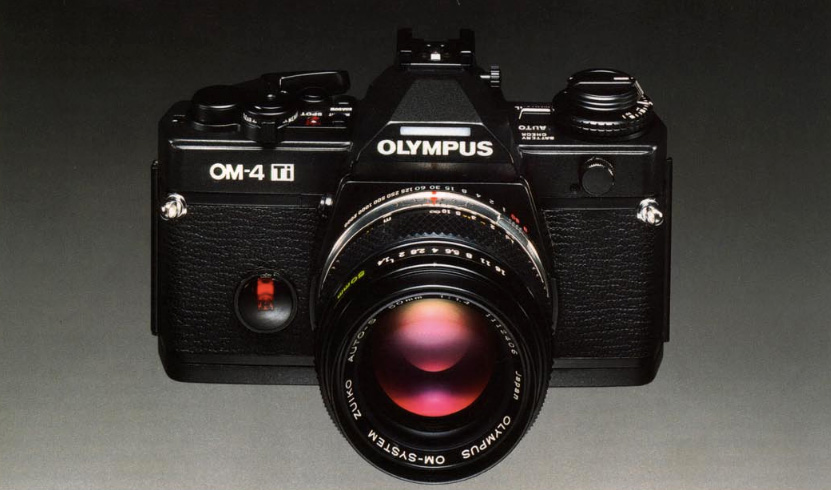
What Made the OM-4Ti Special
The OM-4Ti is, fundamentally, an OM-4 refined to the extreme.
- Titanium Top and Bottom Plates:
Lightweight, incredibly strong, and corrosion-resistant — perfect for professional fieldwork. - Upgraded Weather Sealing:
Improved dust and moisture resistance over the original OM-4. - Refined Electronics:
New circuits fixed the rare power drain issues some OM-4s experienced.
The OM-4Ti is more reliable over long periods without battery loss. - Updated Flash System:
Fully TTL flash metering, improved flash readiness indicators, and better compatibility with Olympus T-series flashes. - Viewfinder Enhancements:
Slightly improved prism coatings for better brightness and contrast.
Olympus didn’t try to reinvent the OM-4.
They just perfected it.
Key Features of the OM-4Ti
- Multi-Spot Metering:
Take up to 8 spot readings and average them for perfectly exposed scenes. - Highlight/Shadow Bias Buttons:
Prioritise bright or dark areas instantly without guessing exposure compensation. - Quartz-Controlled Shutter:
Accurate, durable shutter speeds from 1s – 1/2000s, Bulb,
with mechanical 1/60s and Bulb backups in case of battery failure. - TTL Flash Control:
Full integration with Olympus T-series flashes for through-the-lens flash accuracy. - Motor Drive Compatibility:
Works with Motor Drive 2 for up to 5 frames per second shooting. - Titanium Body Panels:
Top and bottom plates in tough titanium, finished in Black or Champagne Silver. - Mechanical Backup:
Essential shooting speeds available without batteries — vital for expedition work.
OM-4 vs OM-4Ti: The Key Differences
| Feature | OM-4 | OM-4Ti |
|---|---|---|
| Top/Bottom Plates | Magnesium Alloy | Titanium Alloy |
| Weather Sealing | Basic | Improved (professional-grade) |
| Electronics | 1983-era circuits | 1987-upgraded circuits |
| Finishes | Black only | Black or Champagne Silver |
| Flash Readiness | LED | Improved flash feedback and TTL reliability |
Real-world difference?
The OM-4Ti is tougher, smarter, more reliable —
especially when shooting in tough conditions or when leaving the camera unused for weeks at a time.
How to Estimate the Age of Your OM-4Ti
| Serial Number Range | Approximate Production Years |
|---|---|
| 100000 – 300000 | OM-4Ti |
The OM-4Ti had a longer production run than many realise —
and it remained in limited production even after autofocus cameras dominated the market.
Serial Location:
- Top plate near the rewind crank.
Olympus OM-4Ti: Full Specifications
| Specification | Detail |
|---|---|
| Year Released | 1987 |
| Shutter Speeds | 1s – 1/2000s, Bulb |
| Flash Sync | 1/60s |
| Metering Modes | Centre-weighted, Spot, Multi-Spot (up to 8 readings), Highlight/Shadow Bias |
| Exposure Modes | Manual only |
| Viewfinder Coverage | ~97% |
| Motor Drive Compatible | Yes (Motor Drive 2) |
| Batteries | Two 1.5V SR44 or one 3V CR1/3N |
| Mechanical Backup | 1/60s and Bulb |
| Body Material | Titanium alloy top and bottom plates |
Brochures and Manuals for Download
- Olympus OM-3Ti and OM-4Ti Brochure (PDF)
- Olympus OM-4Ti User Manual (PDF)
- OM-4Ti Photography’s Best Kept Secret (PDF)
- Modern Photography, 1986 – OM-4Ti Review (PDF)
- Review Australian Photography, 1987 (PDF)
- Crash Test with Camera Magazine, 1989 (PDF)
Final Word
The Olympus OM-4Ti is the end of a philosophy —
one that put total trust in the photographer’s skill, not automation.
It’s a reminder that true mastery isn’t about technology making choices for you.
It’s about having the right tools — then making the choices yourself.
Built to last.
Built to travel.
Built for those who understood that photography is a craft, not a shortcut.
Even today, a good OM-4Ti doesn’t just hold up.
It inspires.