
In 1987, Olympus took their best professional manual SLR, the OM-4
and made it even better.
Stronger. Smarter. Tougher.
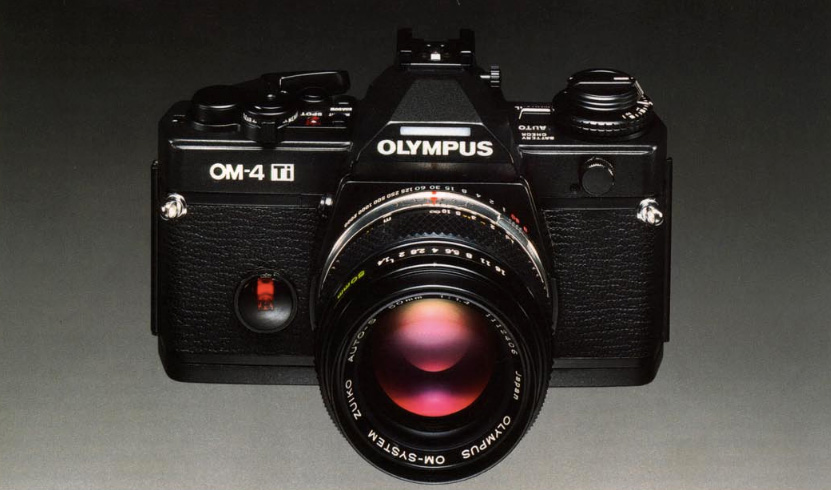
The Olympus OM-4Ti (also known in Japan and Europe as the OM-4T) was the final flagship of the legendary OM System, and it remains one of the greatest manual-focus cameras ever built.
For serious photographers, it wasn’t just another camera.
It was Olympus’s ultimate statement of precision, durability, and photographer-first thinking.
What Made the OM-4Ti Special
The OM-4Ti is, fundamentally, an OM-4 refined to the extreme.
- Titanium Top and Bottom Plates:
Lightweight, incredibly strong, and corrosion-resistant perfect for professional fieldwork. - Upgraded Weather Sealing:
Improved dust and moisture resistance over the original OM-4. - Refined Electronics:
New circuits fixed the rare power drain issues some OM-4s experienced.
The OM-4Ti is more reliable over long periods without battery loss. - Updated Flash System:
Fully TTL flash metering, improved flash readiness indicators, and better compatibility with Olympus T-series flashes. - Viewfinder Enhancements:
Slightly improved prism coatings for better brightness and contrast.
Olympus didn’t try to reinvent the OM-4.
They just perfected it.
Key Features of the OM-4Ti
- Multi-Spot Metering:
Take up to 8 spot readings and average them for perfectly exposed scenes. - Highlight/Shadow Bias Buttons:
Prioritise bright or dark areas instantly without guessing exposure compensation. - Quartz-Controlled Shutter:
Accurate, durable shutter speeds from 1s-1/2000s, Bulb,
with mechanical 1/60s and Bulb backups in case of battery failure. - TTL Flash Control:
Full integration with Olympus T-series flashes for through-the-lens flash accuracy. - Motor Drive Compatibility:
Works with Motor Drive 2 for up to 5 frames per second shooting. - Titanium Body Panels:
Top and bottom plates in tough titanium, finished in Black or Champagne Silver. - Mechanical Backup:
Essential shooting speeds available without batteries, vital for expedition work.
OM-4 vs OM-4Ti: The Key Differences
| Feature | OM-4 | OM-4Ti |
|---|---|---|
| Top/Bottom Plates | Magnesium Alloy | Titanium Alloy |
| Weather Sealing | Basic | Improved (professional-grade) |
| Electronics | 1983-era circuits | 1987-upgraded circuits |
| Finishes | Black only | Black or Champagne Silver |
| Flash Readiness | LED | Improved flash feedback and TTL reliability |
Real-world difference?
The OM-4Ti is tougher, smarter, more reliable,
especially when shooting in tough conditions or when leaving the camera unused for weeks at a time.
How to Estimate the Age of Your OM-4Ti
| Serial Number Range | Approximate Production Years |
|---|---|
| 100000-300000 | OM-4Ti |
The OM-4Ti had a longer production run than many realise,
and it remained in limited production even after autofocus cameras dominated the market.
Serial Location:
- Top plate near the rewind crank.
Olympus OM-4Ti: Full Specifications
| Specification | Detail |
|---|---|
| Year Released | 1987 |
| Shutter Speeds | 1s-1/2000s, Bulb |
| Flash Sync | 1/60s |
| Metering Modes | Centre-weighted, Spot, Multi-Spot (up to 8 readings), Highlight/Shadow Bias |
| Exposure Modes | Manual only |
| Viewfinder Coverage | ~97% |
| Motor Drive Compatible | Yes (Motor Drive 2) |
| Batteries | Two 1.5V SR44 or one 3V CR1/3N |
| Mechanical Backup | 1/60s and Bulb |
| Body Material | Titanium alloy top and bottom plates |
Brochures and Manuals for Download
- Olympus OM-3Ti and OM-4Ti Brochure (PDF)
- Olympus OM-4Ti User Manual (PDF)
- OM-4Ti Photography’s Best Kept Secret (PDF)
- Modern Photography, 1986 – OM-4Ti Review (PDF)
- Review Australian Photography, 1987 (PDF)
- Crash Test with Camera Magazine, 1989 (PDF)
Final Word
The Olympus OM-4Ti is the end of a philosophy,
one that put total trust in the photographer’s skill, not automation.
It’s a reminder that true mastery isn’t about technology making choices for you.
It’s about having the right tools, then making the choices yourself.
Built to last.
Built to travel.
Built for those who understood that photography is a craft, not a shortcut.
Even today, a good OM-4Ti doesn’t just hold up.
It inspires.