

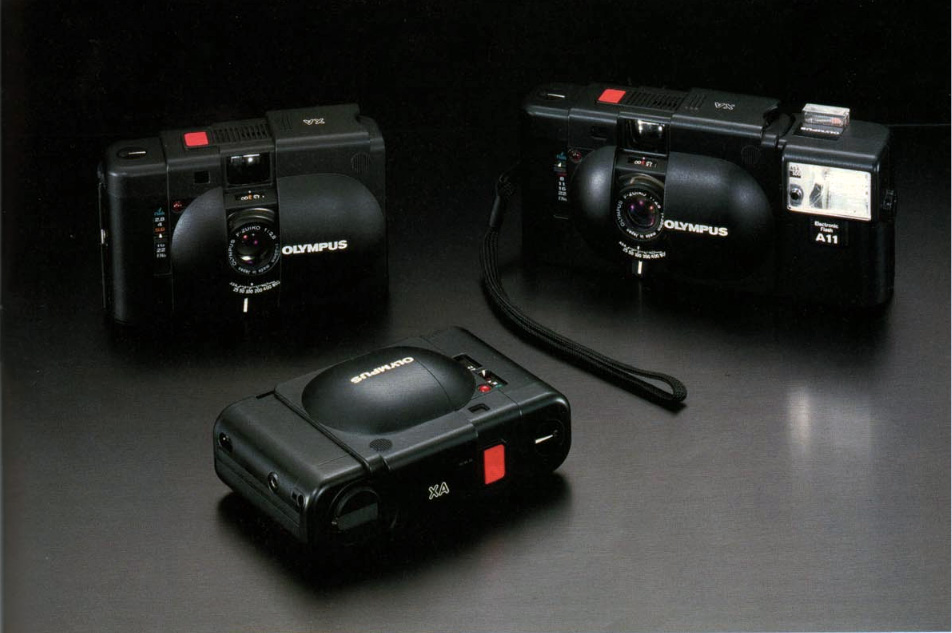
In 1979, Olympus didn’t just release another compact camera.
They released a design statement.
The Olympus XA wasn’t built to look serious.
It was built to be serious — despite its size.
It was the smallest rangefinder camera ever made, but it delivered full-frame 35mm images with precision optics, true manual control, and one of the most iconic sliding clamshell designs in camera history.
A camera you could pocket.
A camera you could trust.
Maitani’s Masterstroke: Simplicity with Purpose
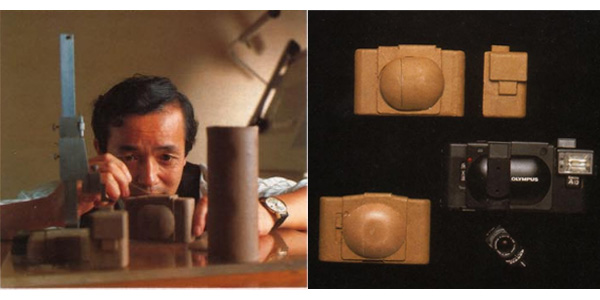
Yoshihisa Maitani believed cameras should disappear in the hand — not shout from around the neck.
After the OM System redefined the SLR, he turned his attention to the compact category.
The brief?
Make the most compact, quiet, and capable 35mm rangefinder in the world.
And so, the XA was born.
A curved, high-strength shell that doubled as lens protection.
No lens cap. No bulging grip. No wasted space. Just pure intention.
Olympus XA: What Made It Special
- True Rangefinder Focusing
With a coupled rangefinder mechanism and a clear patch in the viewfinder, the XA offered precision focusing from 0.85m to infinity — almost unheard of in a pocketable camera. - 35mm f/2.8 F.Zuiko Lens
Razor-sharp. Multicoated. Six elements in five groups. A lens that rivalled SLR glass — and some say, surpassed it in field use. - Aperture-Priority Auto Exposure
Full control over depth of field via a side-mounted dial. The camera set the shutter speed automatically, silently, and accurately. - Backlight Compensation + Self-Timer
With the flick of a switch, you could add +1.5 EV for high-contrast scenes or trigger a short delay for group shots. - Clamshell Design
Slide it open to shoot. Slide it shut to protect the lens. There’s no faster or more elegant way to begin and end a frame. - Weight
Just 225g. And yet, built like a sculpture — with zero wasted lines.
The XA Family: Small Bodies, Big Differences
After the XA’s success, Olympus expanded the line — each version honouring the original’s compact DNA but evolving in purpose.
Olympus XA (1979–1985)
The original. Still unmatched.
- Rangefinder focusing
- Aperture-priority control
- 35mm f/2.8 F.Zuiko
- Ideal for street, travel, and minimalist professionals
Olympus XA2 (1980–1985)
Zone focus simplicity, without losing the Zuiko soul.
- 35mm f/3.5 lens
- Three-zone focusing (portrait, group, landscape)
- Programmed auto exposure
- Instant, intuitive operation
- Most popular XA model sold
Olympus XA3 (1985–1991)
The tech-upgrade to the XA2.
- Same lens and focus system
- Added DX film coding (ISO 25–1600)
- +1.5 EV backlight compensation
- For photographers wanting speed with a bit more automation
Olympus XA4 (1985)
The wildcard. The wide-angle macro specialist.
- 28mm f/3.5 lens (rare in compacts)
- Focus down to 30cm
- True macro photography in a shirt pocket
- Less common, now highly collectible
Olympus XA1 (1982–1985)
The entry-level option. No batteries. No frills.
- Fixed-focus 35mm f/4 lens
- Selenium-cell exposure (no battery needed)
- Viewfinder-only; no rangefinder or zones
- Basic, but surprisingly capable in good light
XA Series Comparison
| Model | Lens | Focus | Exposure Type | ISO Range | Key Features |
|---|---|---|---|---|---|
| XA | 35mm f/2.8 | Rangefinder | Aperture-Priority AE | 25–800 | Full manual precision in a compact body |
| XA2 | 35mm f/3.5 | Zone Focus | Programmed AE | 25–800 | Fast, intuitive, reliable |
| XA3 | 35mm f/3.5 | Zone Focus | Programmed AE | 25–1600 (DX) | DX coding, backlight compensation |
| XA4 | 28mm f/3.5 Macro | Zone Focus | Programmed AE | 25–1600 (DX) | Macro mode, wide-angle lens |
| XA1 | 35mm f/4 | Fixed Focus | Selenium AE | 100–400 | Battery-free beginner’s XA |
Olympus XA Final Word
The XA wasn’t just Olympus showing off — it was Olympus showing how.
How photography could be both serious and simple.
How a tool could fit in your hand without ever getting in the way.
To this day, no other camera series has so elegantly walked the line between form and function.
Whether you’re drawn to the original XA’s rangefinder precision or the XA4’s pocket macro magic, you’re holding more than just a camera — you’re holding a lesson in how less can be infinitely more.
Load a roll.
Slide it open.
Let the frame speak for itself.