

There’s a special kind of optimism reserved for people who buy “untested” camera bundles on eBay.
It’s the same optimism that makes us believe we’ll get fit on Monday, or that the weather will magically hold until we get home.
A kind of gentle, delusional hope we choose to carry because life is simply more fun that way.
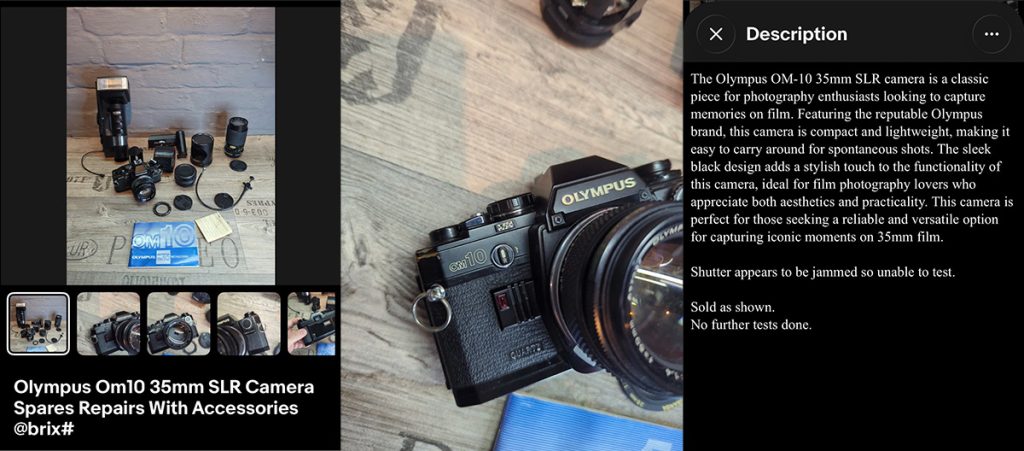
And so, one evening, against my better judgement, I found myself staring at a £42.50 Olympus OM-10 bundle that appeared – depending on the angle – either:
- a hidden gem overlooked by the masses
- or a box of problems wrapped lovingly in bubble wrap
Naturally, I bought it immediately.
The listing photos were… let’s call them ambiguous.
The sort of images taken in a dim hallway with a 2005 digital camera where everything looks slightly better or slightly worse than it actually is.
But the headline features were solid enough to trigger the Zuikography reflex, that ancient instinct that whispers:
That looks like an OM-10 with a 50mm f/1.4. You can’t just scroll past that.
There it was:
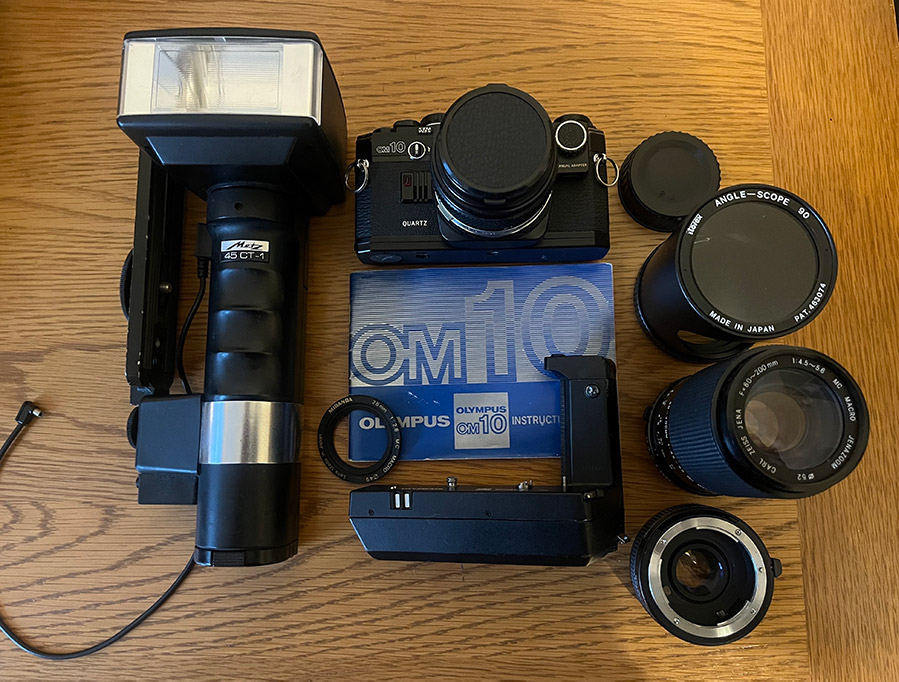
- an OM-10 body
- a mysterious 50mm f/1.4 attached
- a Manual Adapter (the grown-up bit of the OM-10 family)
- something pretending to be a flash
- and a set of additional items that ranged from “possibly useful” to “what in God’s name is that?”
The seller assured me it was “untested”, which in eBay dialect translates directly to:
I know it’s broken but I’m hoping you’re in a good mood.
Still… £42.50.
And every OM shooter has that one story where an absolute bargain arrived and turned out to be a mint-condition treasure.
This… was not that story.
But it was a story.
And so the box arrived.
Time for the autopsy.
What Arrived in the Box
By the time the parcel arrived, expectations were already adjusted.
Buying untested OM bodies on eBay is less about anticipation and more about preparation.
I opened the box like an archaeologist uncovering a forgotten site – carefully, reverently, and with the quiet awareness that anything handled too quickly might crumble.
Inside, wrapped with the enthusiasm of someone who wanted it gone rather than protected, lay the remains of someone’s Olympus dream.
And what a collection it was.
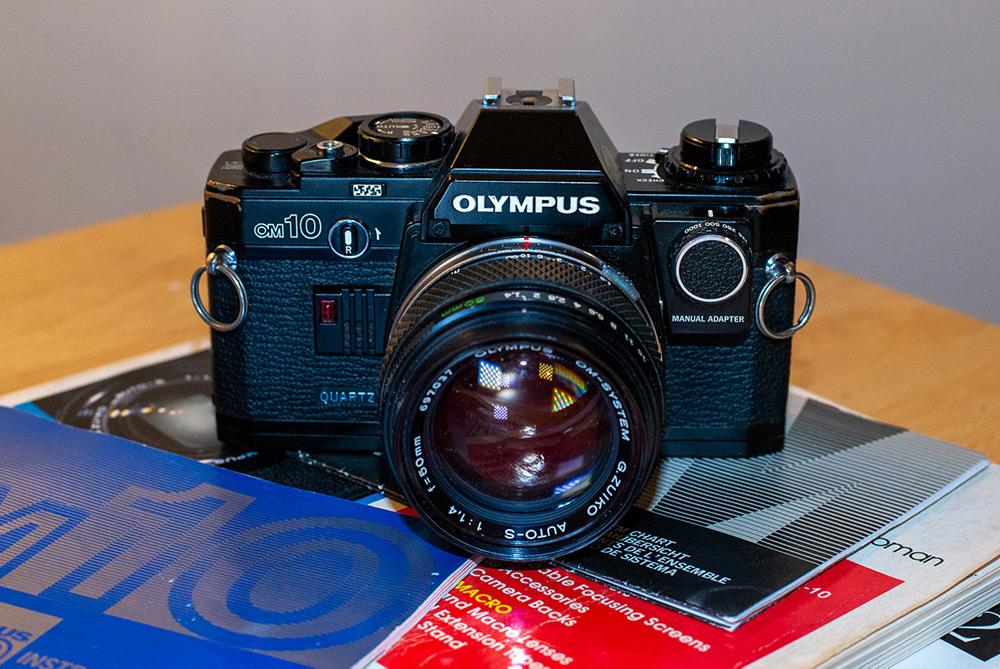
The OM-10 Body – Alive Against All Odds
The first thing to emerge was the OM-10 itself, looking slightly shell-shocked, as if surprised to see daylight again.
Cosmetically?
Not bad at all.
There’s brassing along the edges – the honest kind, earned through use rather than neglect. On a black OM body it adds something I’ve always liked: proof that the camera lived a life rather than sat on a shelf.
Mechanically?
That was a mystery for later.
At first glance, it didn’t look promising. The shutter was jammed, the camera lifeless in the hand – exactly the sort of thing that convinces people an OM-10 is finished.
As it turns out, most “dead” OM-10s aren’t dead at all. They’ve just been written off too quickly.
The Manual Adapter – The Unexpected Win
Next came the Manual Adapter, the little plug-in brain that turns the OM-10 from “training wheels SLR” into something approaching adulthood.
These alone often sell for £15–£20, which means the adapter had just justified half the purchase price before I’d even finished unwrapping things.
A rare win in an otherwise suspicious-looking box.
The Zuiko 50mm f/1.4 – Hope, Followed by Immediate Disappointment
Ah yes.
The emotional centrepiece.
The crown jewel of the listing.
The reason I clicked Buy It Now faster than a toddler grabs sweets.
At first glance?
Perfectly respectable.
At second glance?
A little hazy.
At third glance, with a torch?
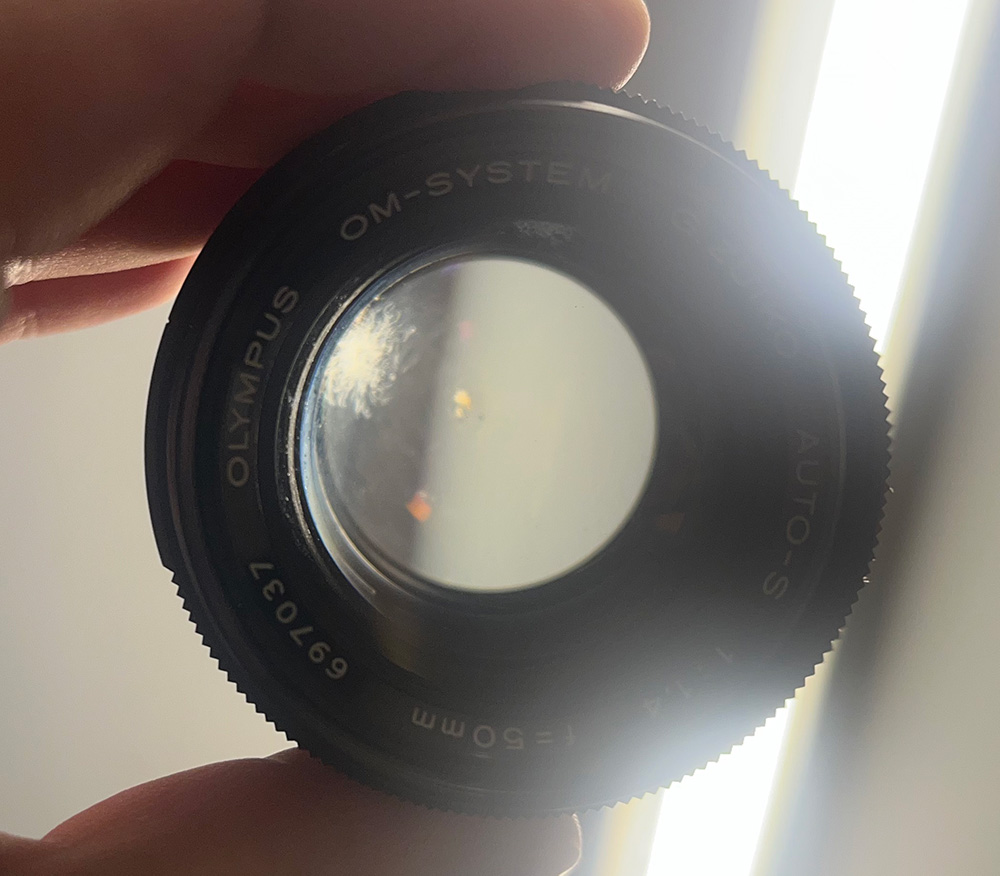
Fungus. Internal. The kind that laughs at home repair.
You know that scene in films where someone taps on a submarine hull and you hear the ominous echo?
That was me tapping the rear optical group.
But more on that shortly.
The Winder 2 – Surprisingly Cooperative
This was a surprise addition – the Olympus Winder 2.
It looks like ambition bolted to the bottom of a camera, and usually behaves accordingly.
In this case?
It works.
Smooth advance, no tantrums, no dramatic battery-draining protest. It makes the OM-10 feel slightly weightier and more planted in the hand – not refined, but confident.
A genuine win.
The Flash – A Device in Name Only
Technically, a flash.
Realistically, a prop.
It didn’t fire when tested, which surprised nobody involved. It looks like it last worked during the Thatcher administration and has been coasting on nostalgia ever since.
Into the “not coming back” pile it went.
The Data Back – The Unsung Villain
No OM tragedy is complete without a Quartz Date Back, that bulky appendage from the 80s that stamped the date onto your photos whether you wanted it or not.
Nobody likes them.
Nobody uses them.
Nobody asked for one.
But there it was, clinging to the OM-10 like a parasite.
For now, it stays.
The “What Even Is This?” Collection
Every eBay lot has a wildcard.
Mine had several:
- a Vivitar relic with fungus blooming like a forgotten apple
- a fake “Carl Zeiss Jena” zoom that wouldn’t mount on anything Olympus-related
- a right-angle attachment apparently designed for photographing around corners — perfect if you’re a pervert, otherwise baffling
- a cable release – the only genuinely useful thing in this subgroup
Together, they formed the perfect still life titled:
The Reason This Lot Was Only £42.50.
The Fungus
Every bargain camera lot has a moment of truth.
A moment when you stop, hold your breath, and shine a torch through a lens while whispering:
Please don’t be fungus… please don’t be fungus…
And then, of course, it is fungus.
The 50mm f/1.4 that came with this OM-10 had internal growth tucked safely between elements – the kind you can’t reach without specialist tools, specialist knowledge, and a willingness to ruin your afternoon.
This wasn’t wipe-away haze.
This was settled, established, paying-rent fungus.
And here’s the truth nobody likes to hear:
If fungus is between elements, it’s game over at home.
But here’s the twist:
Stopped down to f/4–f/8, the lens still produces usable negatives.
Contrast dips slightly, but nothing HP-5 can’t handle with a shrug.
It becomes a character lens – which is photographic shorthand for it’s flawed, but interesting.
Financially worthless.
Educationally invaluable.
Does the OM-10 Actually Work?
With the lens drama behind me, it was time to answer the only question that really matters.
I opened the battery compartment and found batteries that looked as though they’d been fitted decades ago. Whatever charge they once held had long since gone.
They came out. Fresh LR44s went in.
The switch flipped to Auto.
The shutter released immediately.
The viewfinder LED lit up.
The camera hadn’t been broken at all. The shutter hadn’t failed. The advance hadn’t jammed. It had simply been running on batteries that were long past any useful life.
It’s a common OM-10 story, and one worth noting: many bodies sold as faulty are nothing more than electrically exhausted.
With fresh batteries installed, the camera settled quickly.
The shutter fired cleanly across speeds.
The meter responded logically.
The advance was smooth.
The winder behaved.
The light seals, however, were dead – decayed into that familiar grey paste best described as industrial sadness.
Nothing unexpected.
Nothing terminal.
The Honest Maths
Once everything was accounted for:
- OM-10 body: working
- Manual Adapter: working
- Winder 2: working
- Flash: dead
- Lens: optically compromised but usable stopped down
- Extras: mostly landfill
Add the cost of new light seals and you’re into this OM-10 for just under £60.
In return, you get a fully functioning body, genuine accessories, a lesson in lens fungus, and a camera with real character.
That’s a fair trade.
A Comedic Guess at the Camera’s Previous Life
Based on the evidence – the fungus-infested 50mm, the random spy attachments, and the overall archaeological feel – it’s possible to reconstruct the OM10’s previous existence.
It likely went something like this:
- Someone bought it in 1983.
- They attached the 50mm f/1.4.
- They took exactly seven photos of a family barbecue.
- They put it in a drawer.
- They never opened that drawer again.
- The lens grew fungus like it was auditioning for Planet Earth.
- The camera fell asleep.
- It was donated to a charity shop.
- It ended up on eBay for £42.50, which is how all great legends begin.
There is no scientific proof for this timeline,
but the fungus alone suggests at least two decades of complete neglect –
which, strangely, is how many film cameras survive long enough to find new owners.
Final Thoughts (For Now)
£42.50 didn’t buy a perfect OM-10.
It bought a story.
It bought brassing, quirks, compromises, and just enough reliability to make the whole thing worthwhile.
That alone makes it worth understanding properly.
Since opening the box, the light seals have been fully replaced, and the camera is now light-tight and ready for use. For the time being, I’m keeping the Quartz Date Back fitted – not because I love it, but because it’s part of this camera’s history.
What mattered most, though, was how it behaved once film was involved.
That question has now been answered — not in a test or a checklist, but by taking the camera out and using it repeatedly, exactly as it is.
Part Two continues the story: The £42.50 OM-10 That Changed the Rules