

By the late 1980s, the age of mechanical cameras was drawing to a close.
Electronic autofocus SLRs were taking over.
But Olympus had one final statement to make.
The Olympus OM-3Ti — released in 1994 —
wasn’t just a reissue of the OM-3.
It was a masterpiece in its own right:
a mechanical SLR built to a standard few cameras, before or since, could touch.
Stronger. Smarter. Scarcer.
And for those who know, still one of the finest 35mm cameras ever created.
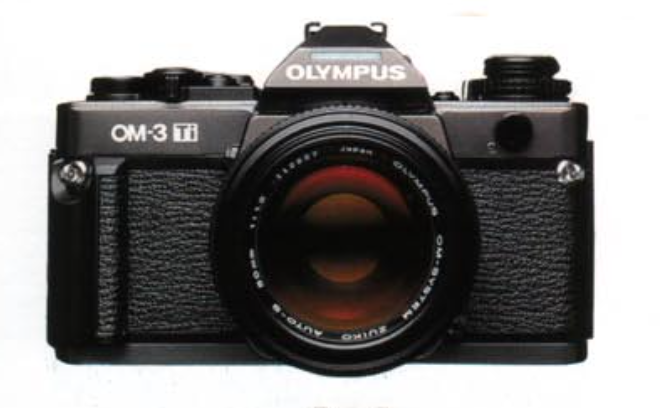
What Made the OM-3Ti Special
The OM-3Ti carried forward the soul of the OM-3:
- Fully mechanical shutter (1s – 1/2000s, Bulb).
- Sophisticated multi-mode metering (Spot, Centre-weighted, Highlight/Shadow bias).
But it added major refinements:
- Titanium Top and Bottom Plates:
Stronger and lighter than the magnesium alloy of earlier models.
Available in both black and champagne finishes. - Improved Sealing:
Better dust and moisture resistance — close to professional “weather-sealed” standards of the time. - Updated Circuitry:
More reliable electronic components for the light meter and flash communication. - Improved Viewfinder:
Slightly brighter, higher-contrast prism coatings.
Despite being released when film SLRs were declining,
the OM-3Ti was a no-compromise tool —
built for professionals and dedicated amateurs who understood that control mattered more than automation.
Key Features of the OM-3Ti
- Fully Mechanical Shutter:
Runs entirely without batteries.
Battery powers light meter only. - Spot, Centre-Weighted, Highlight/Shadow Metering:
Same multi-mode brilliance as the OM-3. - TTL Flash Metering:
Supports Olympus T-series flashes for through-the-lens flash exposure. - Motor Drive 2 Compatible:
Full motor drive system integration if needed. - Sealed Titanium Body:
Extra strength and weather resistance over the standard OM-3. - Mechanical Backup:
No batteries required for shutter operation — perfect for remote work, cold weather, or expedition use.
OM-3 vs OM-3Ti: The Main Differences
| Feature | OM-3 | OM-3Ti |
|---|---|---|
| Top/Bottom Plate Material | Magnesium alloy | Titanium alloy |
| Body Sealing | Basic | Improved dust and moisture resistance |
| Electronics | 1983-era | Updated 1990s circuits |
| Finishes | Black | Black or Champagne |
| Production Volume | Modest | Very limited |
The OM-3Ti wasn’t just more durable —
it was rarer, sharper, and built with an attention to detail that made it one of the very last true “photographer’s cameras” ever made.
How to Estimate the Age of Your OM-3Ti
| Serial Number Range | Approximate Production Years |
|---|---|
| 100000 – 130000 | OM-3Ti |
Production numbers were very low —
and many OM-3Tis saw professional use, making pristine examples highly collectible today.
Serial Location:
- Top plate near the rewind lever.
Olympus OM-3Ti: Full Specifications
| Specification | Detail |
|---|---|
| Year Released | 1994 |
| Shutter Speeds | 1s – 1/2000s, Bulb |
| Flash Sync | 1/60s |
| Metering | Centre-weighted, Spot, Highlight/Shadow Bias |
| Exposure Modes | Manual only |
| Viewfinder Coverage | ~97% |
| Motor Drive Compatible | Yes (Motor Drive 2) |
| Batteries | Two 1.5V SR44 or one 3V CR1/3N (for meter only) |
| Body Material | Titanium alloy (top and bottom plates) |
| Available Finishes | Black, Champagne (Silver) |
Brochures and Manuals for Download
- Olympus OM-3Ti User Manual (PDF)
- OM-3Ti Review – Amateur Photographer, May 1995 (PDF)
- OM-3Ti and OM-4Ti Brochure, 1996 (PDF)
Final Word
The OM-3Ti was Olympus’s love letter to the mechanical SLR —
the absolute best they could build, even as the world was moving on.
It’s not a mass-market camera.
It’s a precision instrument — for people who know exactly what they’re holding.
Tougher than titanium, simpler than silicon, truer than automation.
A camera built to endure, even when the world didn’t seem to want it anymore.
And that makes it even more remarkable.